Uncategorized

WIP #1, now a nearly FO: The notes.

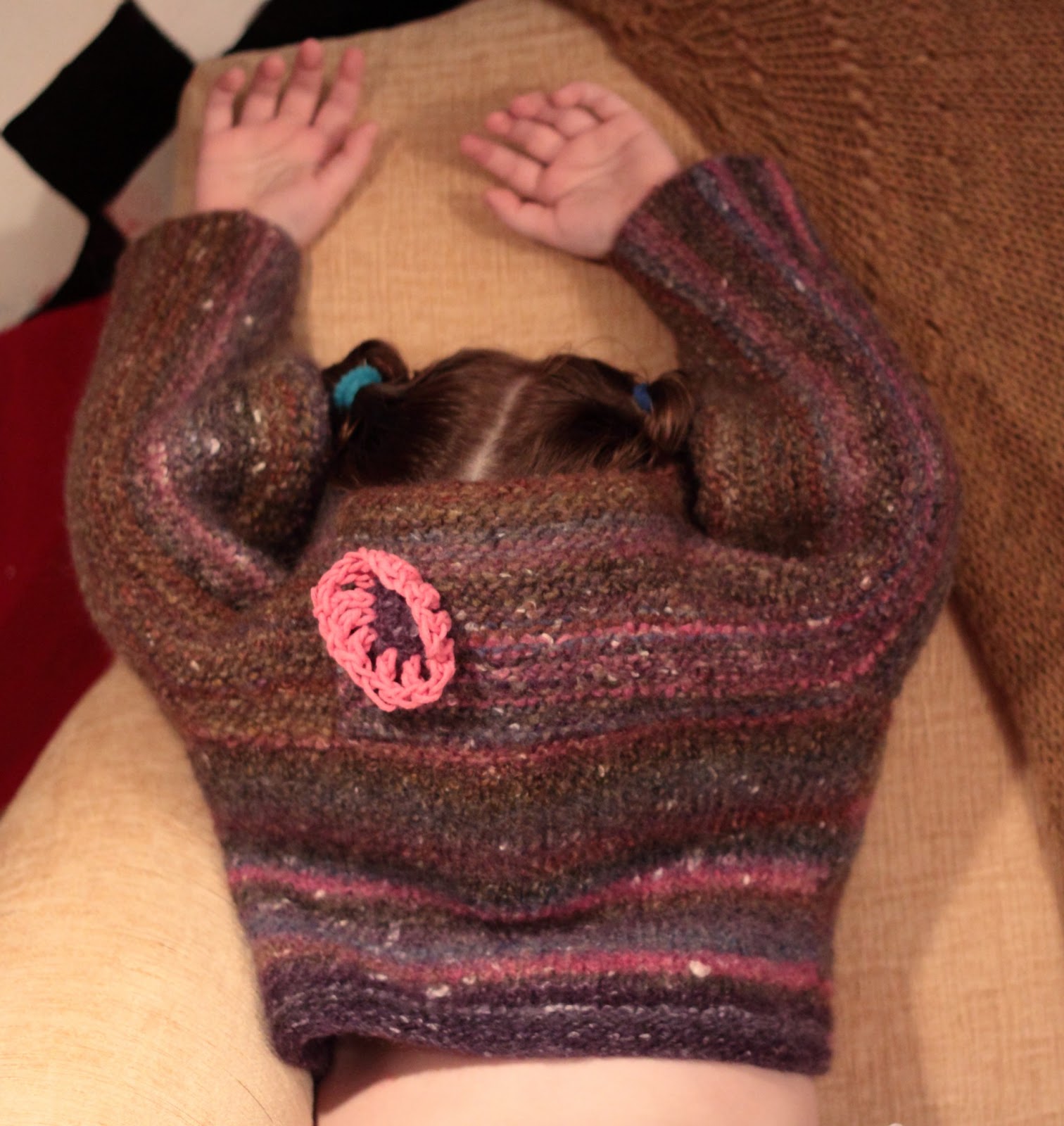
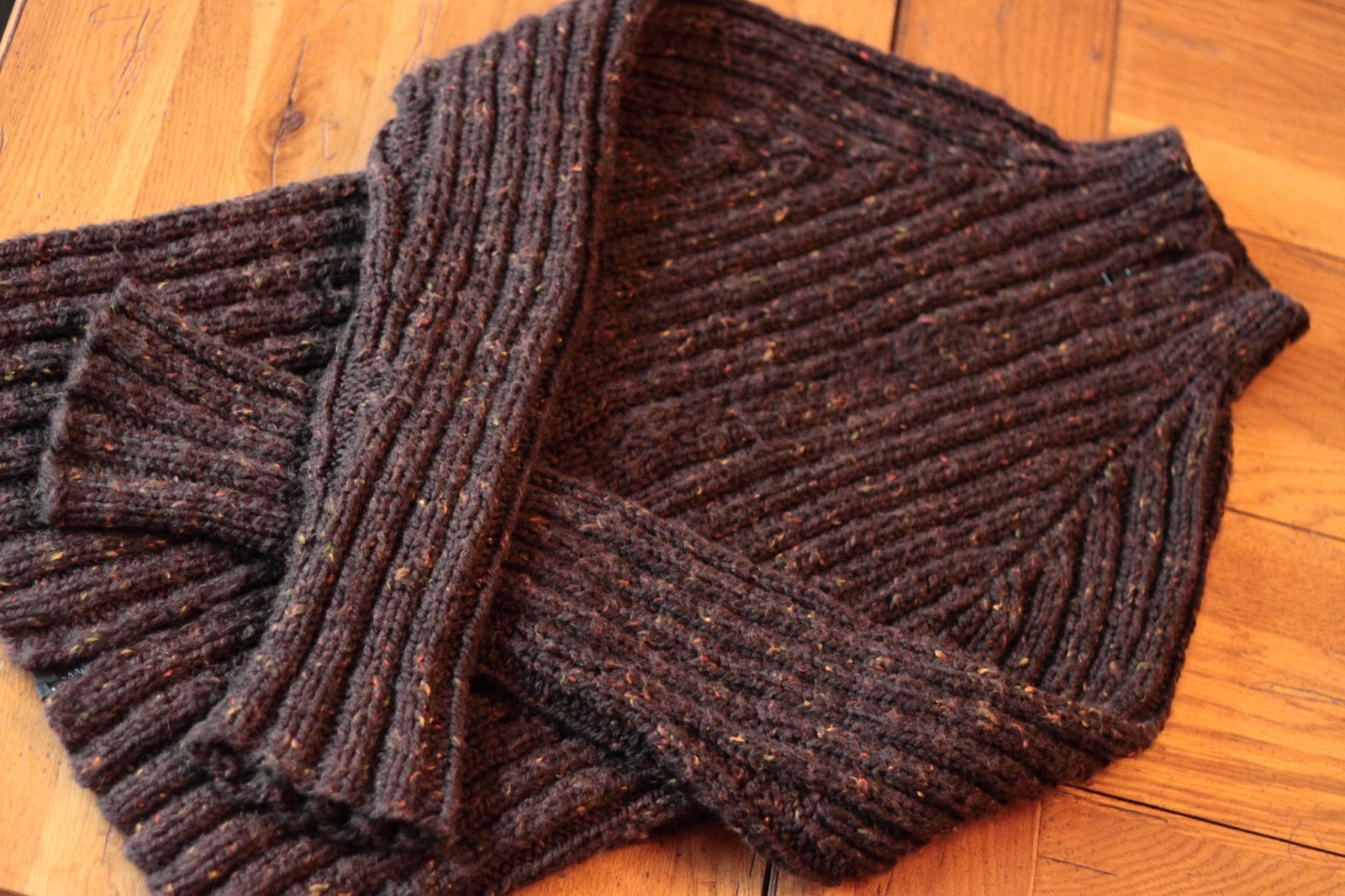
The final product…sort of

I have completed my first WIP for the year. I love it and wear it now as I enter this post. My goal was to reproduce a similar sweater, though I made mine simpler than the original. My confidence boosted, I will feel ready next time to add more of the details in the original and maybe even use some Spud&Cloe Outerwear yarn to do it!

It was fun to make design decisions as I worked with Ann Budd\’s generic \”bones\” for a raglan cardigan and to make it my own.

Here are my decisions, why I made them and what I learned from this project:

1. I wanted a fitted sweater, so I chose not to add a button/buttonhole band. Instead, I sewed in a zipper. I also made the entire sweater in 2×2 ribbing, causing the finished fabric to \”draw in,\” while still have nice give and enough stitches to be a comfy fit. I made a size 38\” finished bust in 4st/inch with Patons Shetland Chunky Tweed, brown. When choosing the size, I also remembered to consider that most sizes that should fit me (usually should be able to wear a size smaller and store bought or in knitting patterns according to my actual bust circumference) usually do not fit my shoulders. Thus, I jumped up a size. For more info on this, check out Amy Herzog\’s Fit to Flatter here.

Basting? I think so. Maybe I will
even cover it in some flannel fabric….

2. The zipper, lightweight and sturdy, also accomplished an \”indoor/outdoor\” feel to the cardigan. (I found it in my Grandma Miller\’s zipper stash) It is 26\” long to come up almost all the way to the top of the split funnel collar to add more \”coat\” feeling.

Even though I am a sewer as well as a knitter, I used Deborah Newton\’s \”Finishing School\” for some good advice on installing a zipper into knitwear.

She also is a sewer (and a former costume designer, learn more about her here) and gave this important advice: sewing zippers into knitwear is NOT the same as traditional sewing installation! They are handsewn with larger stitches, and an up and down \”poking\” motion, VERY different than my past experiences with machine sewn installation. This was my first time and it turned out okay. The finished appearance is nice from the outside, but I may tidy up my stitches next and treat the originals as basting so the back/wrong side looks more professionally done. Just in case I needed to do this, I planned ahead and used lighter colored yarn than the zipper or sweater yarn for the \”basting.\”
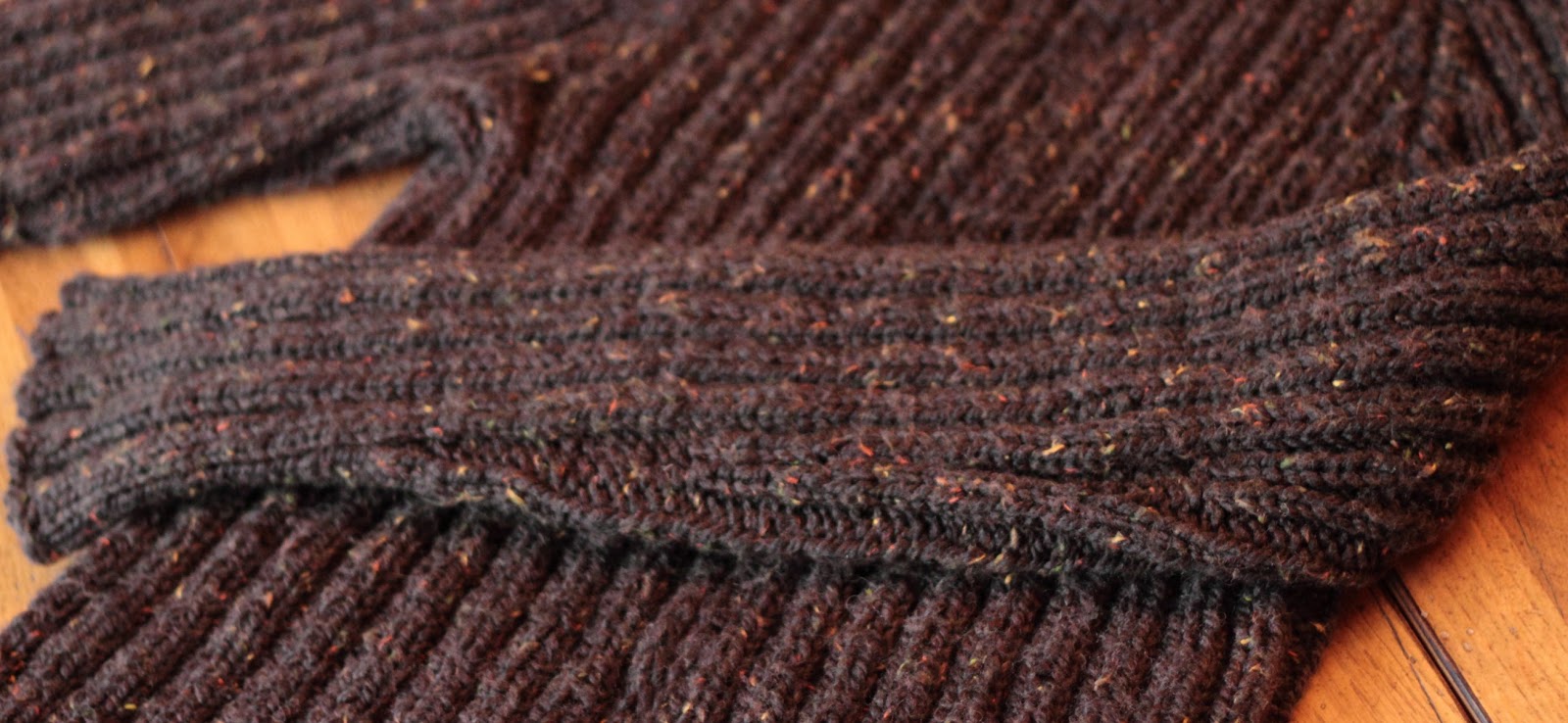
This pic shows the increases I used. I basically just increased
while following the ribbing pattern as it presented.

3. To get long, cozysleeves, I had to add 3 inches to the original sleeve length (I also have long arms). This gave a more modern appearance, and also gives the option to make cuffs by turning them up. A person could even add an eyelet/button hole style spot to put a thumb through at the end, make a sort of fingerless mitt and the edge. hmmm….might have to try that…
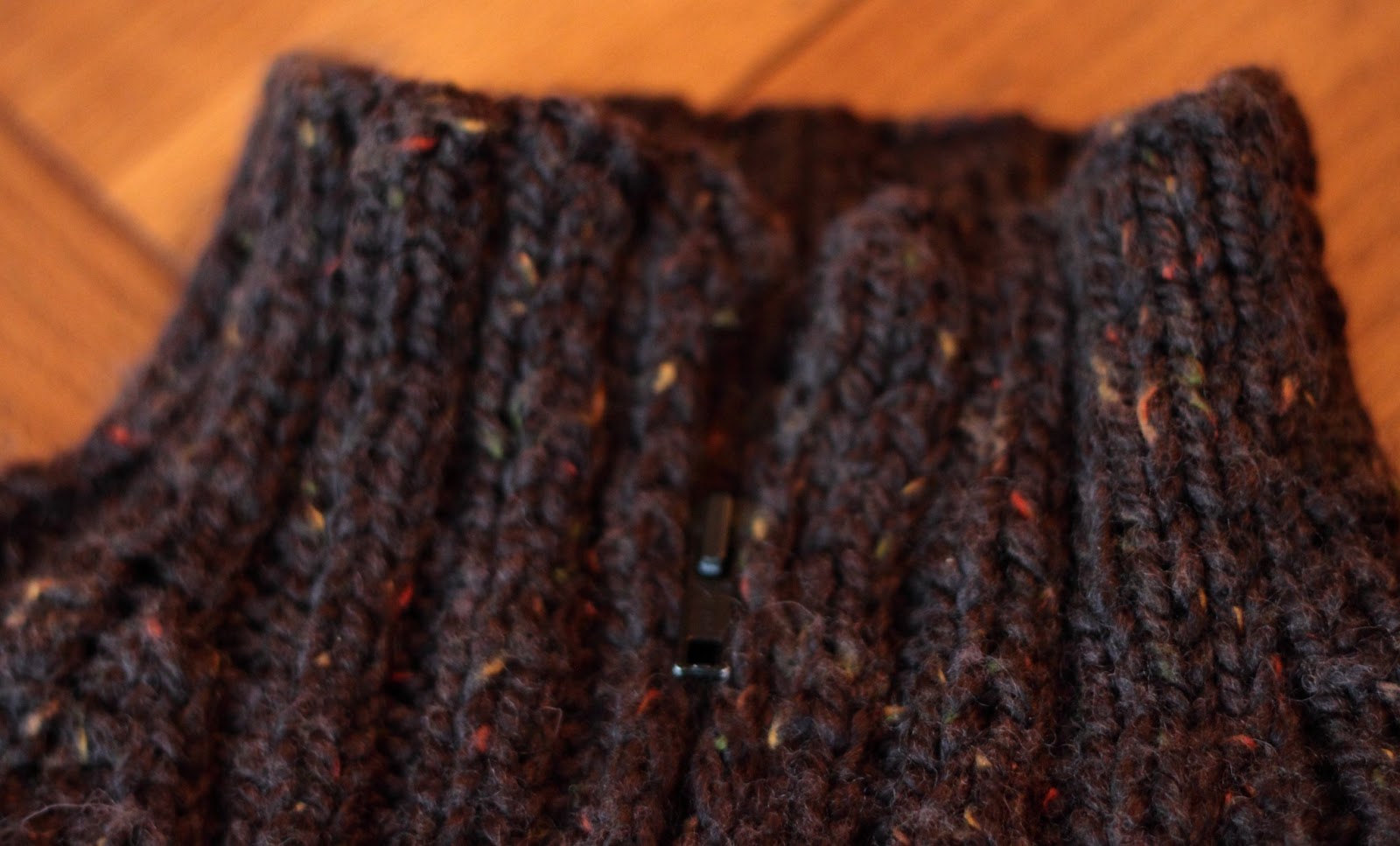
The zip does not go all the way up so as not to scractch my
chin/neck

4. The collar stands up pretty nicely with the thicker yarn as I wanted a mock turtleneck style (does that phrase give away my 80\’s growing up?). The top edges of the zipper also help. I left just enough space at the top to allow a little split so as not to constrict the neck area. This was something a bit (very tiny bit) annoying in the original sweater.

I did not use the crew neck shaping and BO followed by picked up stitches for the collar as given in the training wheels pattern. When the raglan shaping was done, I just kept knitting in the rib pattern all the way to the end of the collar to add continuity. I also did not want the collar to slope away from the center, since I wanted the zipper to go all the way up, nearly to the top.

5. Difficulties: This pattern is knitted from the bottom-up. When attaching the sleeves to the body, the tension is pretty, well, tense at those joins for a few rounds. For me, this created ladders along the first few rows of ragalan shaping. I sewed them up for the most part, but am considering doing a single crochet \”edge\” along the seam from the inside of the sweater in a smaller yarn, just to add some strength to the join areas.

6. This brings me to the yarn. In my experience, this yarn tends to be very soft and droops with time. Due to this characteristic (especially since I made a large sweater with chunky weight in the Patons), reinforcing the raglan seams altogether seems like a good idea. Already, I can tell that the weight of the sleeves may be a pull in the future.

I look forward to doing this again with a higher quality yarn, such as the Spud&Chloe I mentioned above. Maybe I will try a smaller sweater for Amy Rose to practice the joins.
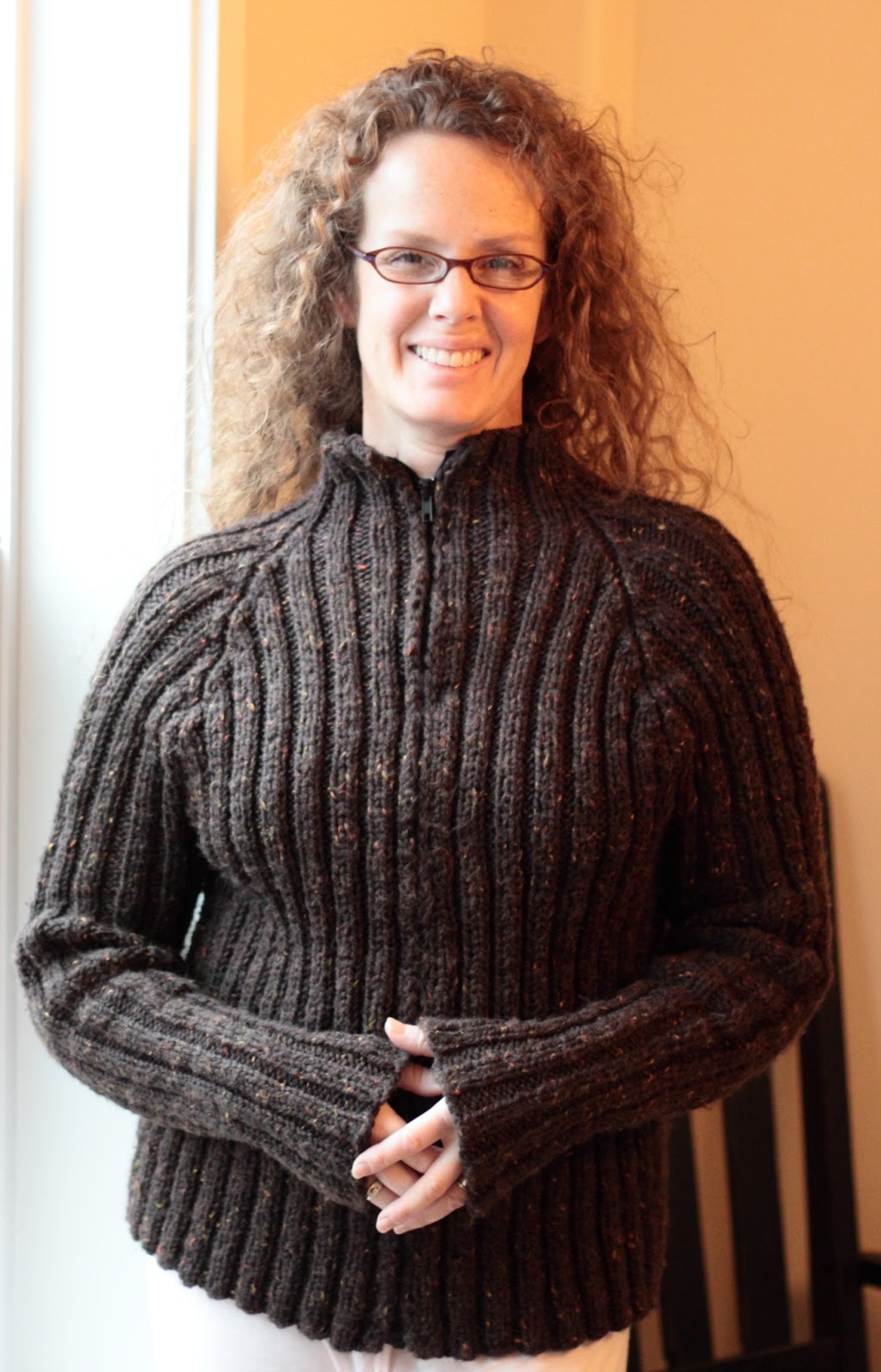
Me in the a.m. after coffee but before
shower. Forgive me.

Summing it up: This sweater took me about 2 weeks to complete. This was evenings and weekends and a couple of marathon hours (4 at a time) on my days off. Ann Budd\’s book is very helpful and I would recommend it to anyone who wants to design their own sweater but are afraid to do it from scratch.

A note on finishing: I really liked the advice found in Newton\’s book on finishing. Those little things really matter and when we spend so much time and effort on our work, why not go that that little extra step to make the final product so much more awesomer? (Yes, awesomer.)

I will make more sweaters/projects from both books and I look forward to improving my knitting skills!

Next up: a pair of socks to stay awake at all day meetings…
Uncategorized

Sweater Reproduction: WIP #1

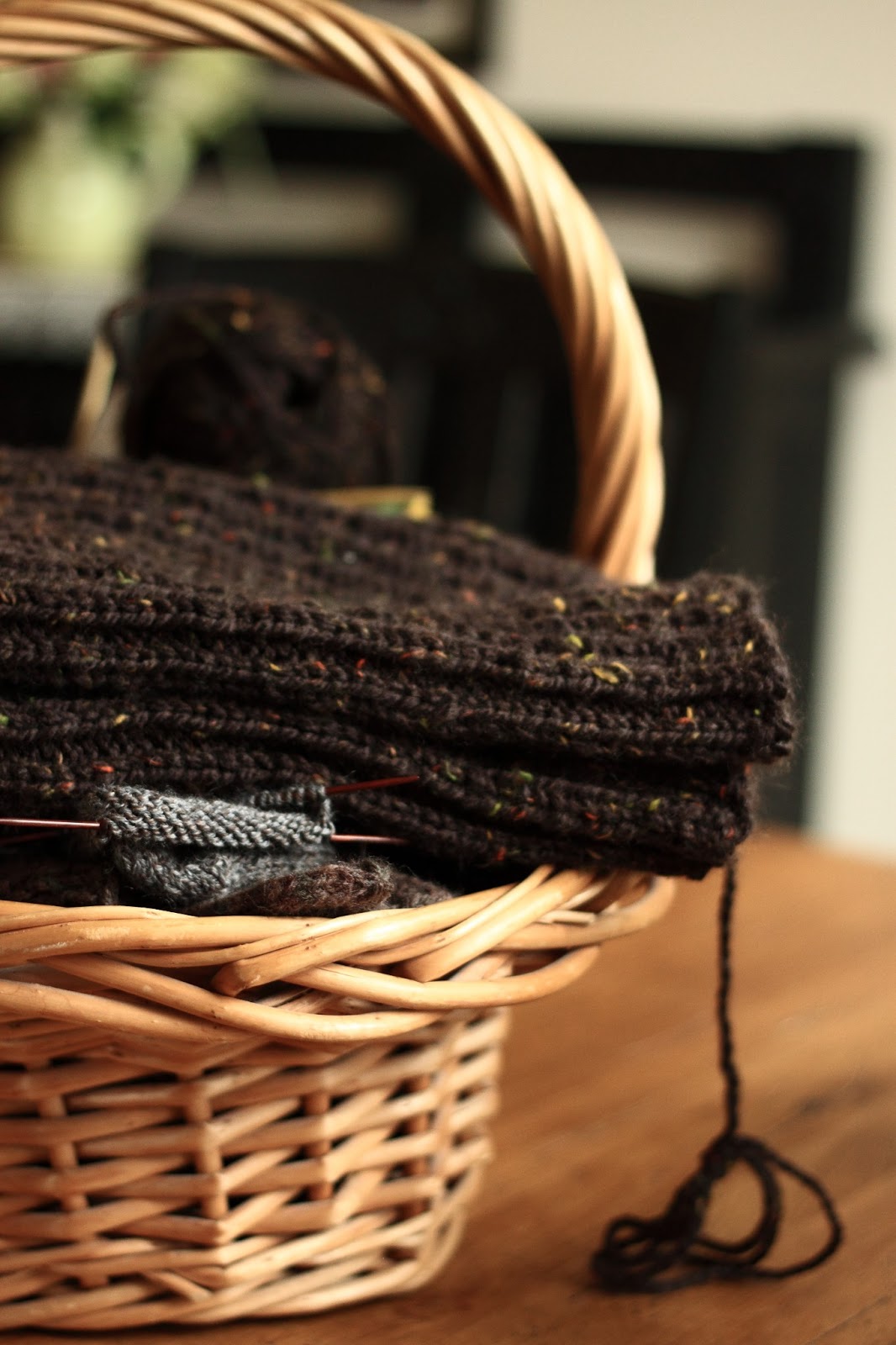
Done so far: body, sleeves and 50 percent of
the crewneck (before adding a collar)

I have always wanted to recreate a particular sweater of mine. I bought it at the Goodwill a while back. It is a light green cardigan with a front zipper and a few cables on it. It was originally from The Gap (and since they may go out of business, I hear, it may become collectible soon!). From what I can tell, it is knitted in a bulky weight yarn at about 4 stitches to the inch. It is a raglan cardigan in wool and cotton, and  is ribbed on the front, stockinette on the back. It has a high collar that does not turn down, and it very nicely fitted. It is a big fav of mine to wear around the house, to take a walk, or go to the store….just about everywhere.

I wear it so much that it is really starting to show its age and I figure I had better get to work on reproducing it before it wears out. After all, it came to me used in the first place–I might not have long!

To accomplish this, I am going to start learning more about sweaters. I have only made about 5 of them in my knitting life and, while I have a general idea about their construction, my knowledge is limited to only those sweaters I have made. Besides, I just don\’t feel confident enough to step out on the sweater design limb just yet–not completely.

I have decided to use some training wheels in my endeavor. Ann Budd has a great book, The Knitter\’s Handy Book of Sweater Patterns, which is working out great for this project. In it, she gives basic instructions for different sweater designs, with a wide allowance for your own stitch patterns, collars, length, etc.

I have decided to keep my first try at this simple. My sweater will be completely ribbed for a fitted feel and will have the same stand up collar. It is going to be a cardigan with a zipper on the front (using another book for the installment of that later on) and will be knitted in brown tweed, Patons Shetland Chunky Tweed.

For the sleeves: I watch a lot of Downton Abbey while knitting,
which made it hard to pay attention to my sleeve increases.
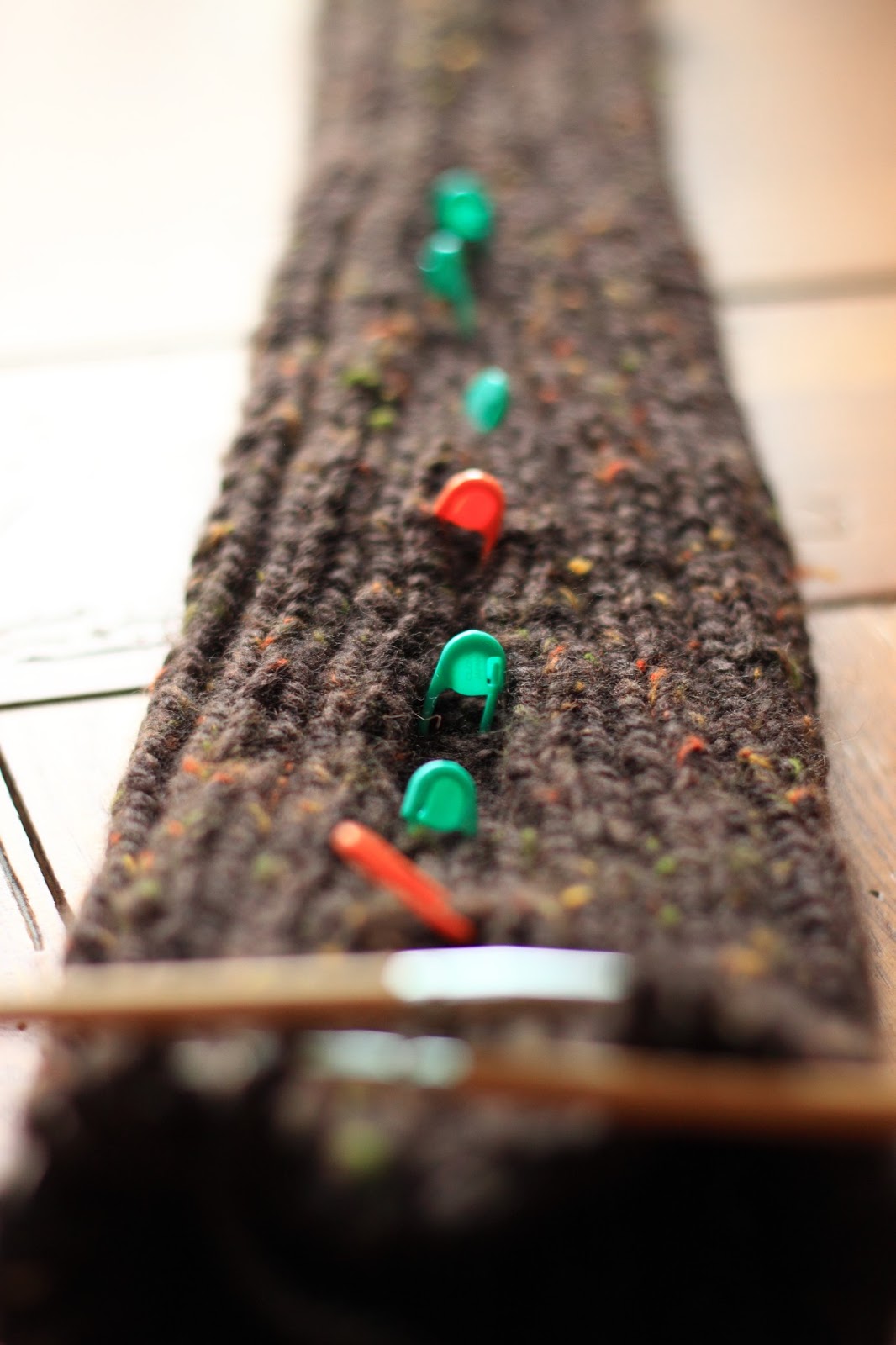
I used stitch markers to mark every increase, so that I
only have to keep track of the stitch markers. Every marker
equals 2 stitch increases, and I needed 8 in total.

Ann Budd uses a seamless construction knitted bottom us for this particular style, which is interesting since I have only tried top-down for a seamless sweater in the past. It is very clever in design. The only thing I have run into that has been a bit difficult is the tension in the fabric once the sleeves, which are knitted separately from the body, are attached to the body. There seems to be quite a bit of pull on the join areas on either side of the sleeve until you knit a few rows and mine is going to need a little sewing to cinch a few spots up.

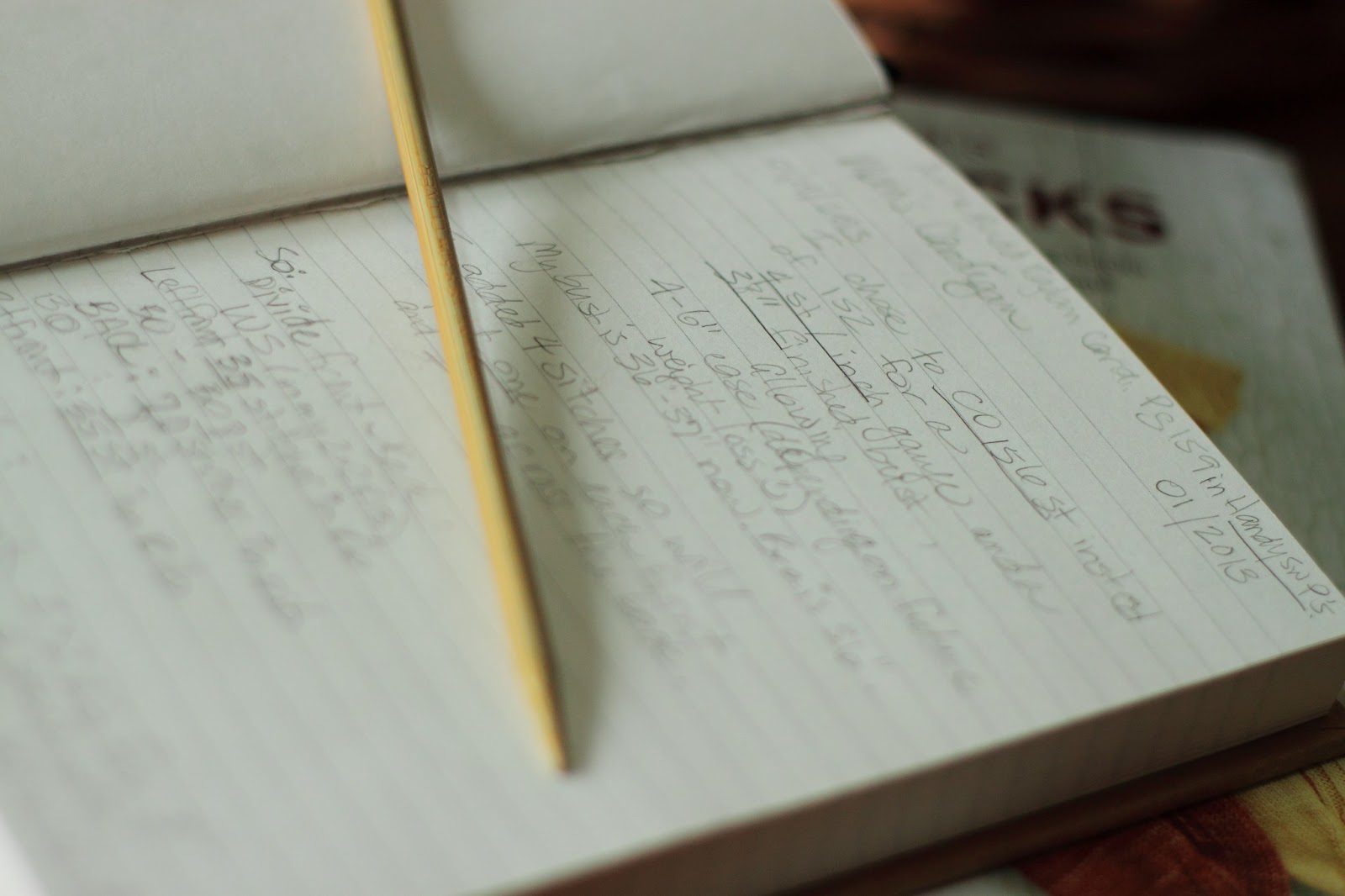
Keeping track of everything I do so that I may refine
this design in the future.

Other than that, I can hardly put it down! It\’s like a good book that you can\’t stand to stop reading–at every step of the way, I just have to see what happens next!

Uncategorized

Calling All Solitary Knitters! Get Plugged In!

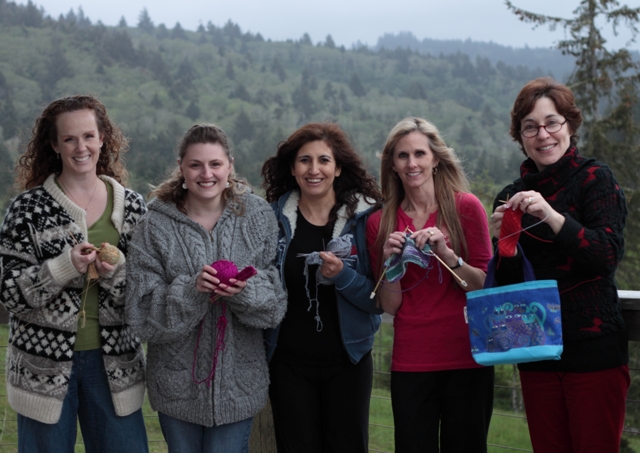
Some of my peeps on a weekend knitting trip. We stayed up till 2 a.m.
every night just knitting our brains out and being together. We love each
other so much, that we call our group \”The Sisterhood of the Clickin\’ Sticks.\”

Early on in my knitting life, I learned one thing very quickly: there are an unfathomable number of knitters out there!

You may not recognize them right away, but they are there. And they are waiting to befriend YOU.    

In the U.S., we have a very individualistic society. Ask any sociology major (or anyone with eyeballs) and you can easily start a discussion on many topics from why we build fences around our yards, to the concept of pursuing one\’s own dream, to the preservation of individual expression, to even, perhaps, why most U.S. restaurants do not serve food family style.

But if the conversation ever turns to the subject of knitting, you will find an interesting paradox.

In one of the most indivualistic cultures in the world (perhaps the most, in fact), we find individuals  who frequently strive to–no–feel driven to find creative ways to do a very individual activity together. They are the knitters.

In spite of the fact, that each one must ultimately produce his or her own final product with their own hands (most of the time), knitters find a way to make the actitivity a group effort.

They meet other like minded folks and create friendships and groups not only in Local Yarn Shops (LYS), but also in their churches, workplaces, libraries and other more unlikely places: here in Vancouver, Washington, even a local grocery store started a knitting night. And it is well attended.

And as if those local groups are not enough for us, we also carry on in a big way internationally–online at sites like Ravlery or in person through worldwide knitting tours to places like Iceland (that one is on my bucket list–I met a sheep herder from Iceland the other day and he was excited at the prospect of our work knitting group visiting his family there, but I digress) or the UK (also on my bucket list–I am descended from the Macleans of Duart Castle on the Isle of Mull…digressing again…). The point is, knitters want to knit together.

Once knitters are assembled and organized, they get shit done. Sorry, that\’s the fact, and I am no one of authority to deny it.

Knitters function like a world class, well oiled team of pros. If we were a football team, we would win the Super Bowl every year. If we were an olympic team, they would eventually ask us to stop competing so others could have a chance to win the gold medals.

I am not talking purely about skill–though there are some knitters out there who produce nothing less than their own works of art each and every time they set their hands to the needles–I am simply talking about community.

Knitters as a larger group stick together in a way that rivals religion. There is no cultural boundary, no mountain, no ocean that can prevent the knitting connection. You want help with a project? You will find it in spades. Skill building? It is at your fingertips if only you look. Community efforts to help the homeless? You got it. Friendship? Some of the best you will ever find–and then some.

How do you tap this resource? If you are not connected, but want to be, there is one step:

Open your mouth.

My dining room table where we sometimes sit and knit for hours on end.

Chances are you are already around other humans every single day, right? You can bet your last dollar that some of them are knitters. And they want to know you. Open up to someone. Have you ever started up a random conversation about knitting? Asked someone if they made their scarf? Admired a sweater, following the complement with the question: \”who made it?\”

I have. And we now have nearly 25 people in our knitting club at the dental office where I work including staff , patients and freinds and neighbors of each.

Most of you are likely already connected with knitting friends, co workers, and fellow fiber lovers. If you are, take a moment to reflect on your good fortune. But if you aren\’t, suprise yourself with what is already around you. It\’s time to get on board, climb on in, step in time, catch the wave, click those sticks, get online and get in touch.

We are waiting for you.


*I have provided a mini guide to connecting with other knitters for anyone interested in the upper left corner of the blog with a few ideas! Get your own ideas flowing, and happy knitting!

Uncategorized

George was Right: Cold Water DOES Cause Shrinkage! The OOPS! Files.

I should have put on my thinking face.

 I thought I had it. I was sooooo smart. My hubris was clearly my first mistake.

I have been doing laundry most of my life. I could not have said that at 15 years old, or at 25 or even at 30. But now, at 43 years old, I have had 30 years of total laundering experience; more than 50% of my life has been spent as \”the person who does the laundry.\” Alas, 30 years of washing has not been enough–not enough to save my precious hand knits from certain and unforseen doom.

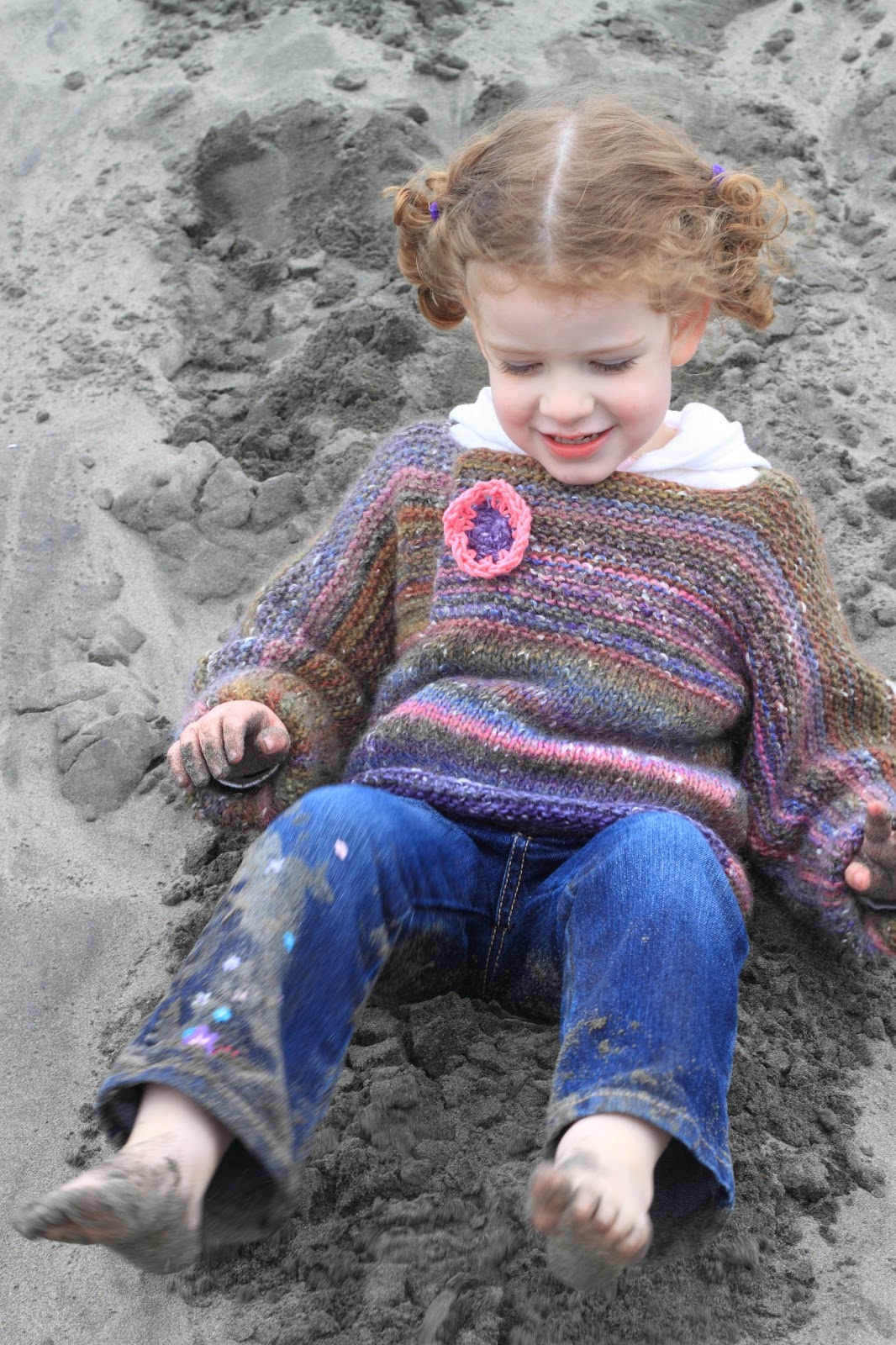
Amy frolics in the sand, not knowing what it
ahead.

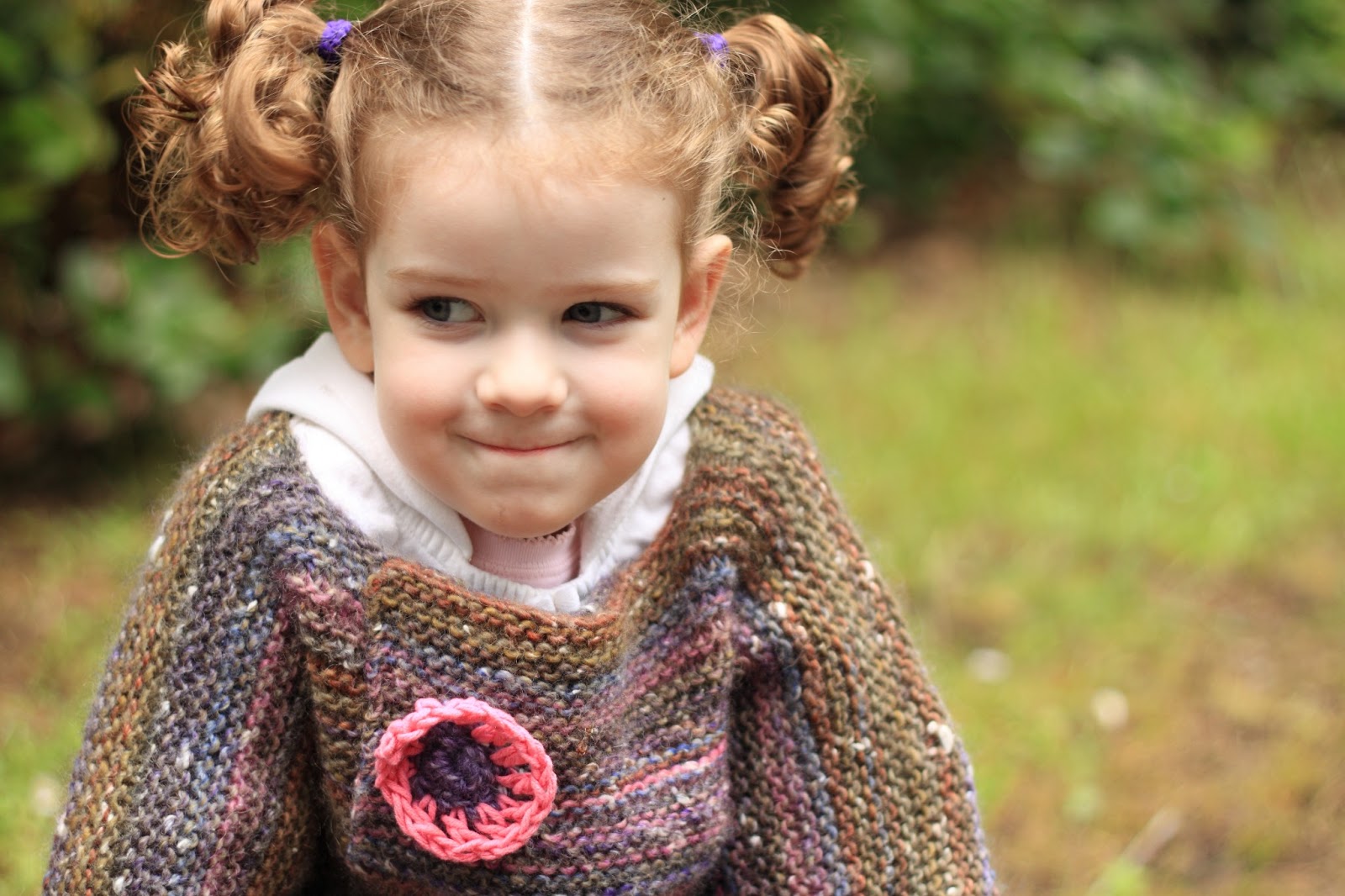
In one my more stupider moves, (yes, I said \”more stupider\”) I single-handedly destroyed one of my favorite hand knits: my Petite Facile by Meghan Jones  from the Winter 2011 issue of Interweave Knits, made for Amy Rose.

I made it last spring for our Memorial Day weekend trip to Fort Stevens, which is at the Oregon Coast and can be a cozy, albeit damp and cold place. I used some precious Plymouth Mushishi in wool and silk to knit this adorable (and very warm) sweater. No, my preschooler was not going to suffer the cold and wind as we hiked on this trip!

Making this sweater even more special, was the fact that this was a first: The project turned out with nice, even tension throughout and nice, straight, tidy edges. And I even lengthened the sleeves to accomodate a turned up wrist cuff. I was very proud of it. It was perfect. Until…

Upon returning from camping, the sweater was worn a few more times. Fellow mothers know that, in spite of careful use, there is no such thing as an ever-clean guarantee when it comes to garments worn by very active preschoolers. I had been avoiding it, but the time eventually came when I had to face it:

The Wash.

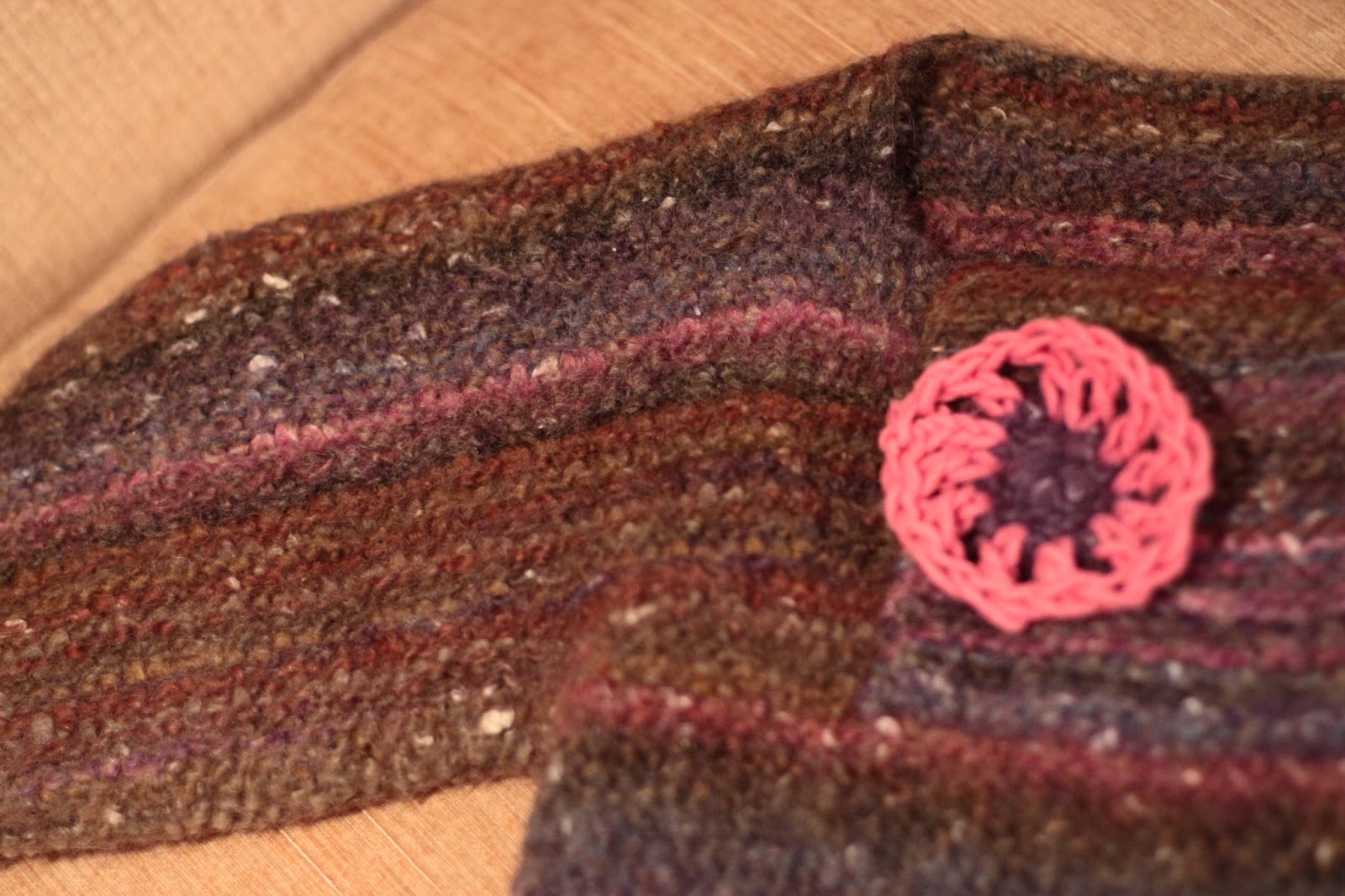
Felted!

This would have been fine (maybe) had I done the wash on a weekend, in the morning, when my coffee buzz was in full swing and the sun was shining on a day with no soccer practice or dance classes. However, I wisely chose to do the laundry after a hectic workday, at night, in the late summertime dark after dinner, dishes, and a 3-year-old\’s bath time, which falls right before the same 3-year-old\’s bedtime.

We all know that nighttime rituals are carefully orchestrated feats of mental and physical prowess,  requiring delicate balances of love and coercion, care and speed, reward and punishment. There are intricate dances between homework, housework, husbands, children, cats, mealtimes, bathtimes and bedtimes. Each needs attention in its sequence. There can be no slip ups in timing, especially as it relates to preschoolers waiting for their stories before bedtime. It would be better to be a tight rope walker in a large circus who misses a step while working without a net. I was taking a chance sneaking in some laundry.

I had about 30 seconds.

I decided to \”save time,\” and put all the dark clothing in the washing machine together. I even felt that this was an advanced washing technique. After all, don\’t all those commercials for laundry soap brag that in cold water, you can mix the colors in the same load? I further patted myself on the back knowing that (as I tossed the little precious sweater into the front load washer without the agitator) the missing agitation + the cold water=no felting for my sweater. After all, I had washed many a commercial woolen sweater in my day. I knew what I was doing. Right?

WRONG.

Amy can\’t even get her head into the hole now.

As I read once (I wish I could say it was after the ruined sweater, but I am embarrassed to say that it was before the fact) in Clara Parkes\’ Book of Yarn, fibers felt, in part, due to the scales from the fleece. They are separated in the strands of yarn, but when washed, the agitation alone can rub them together and sort of bring them back together, irreparably shrinking the knitted fabric.

Of course, the shrinking depends on other things too. In the presence of heat, for example, the shrinkage is greater. But no matter. In my example, agitation and cold water were enough. Even though I have no center agitator like top load machines, the other clothes in the load were enough to cause enough damage to make the garment unwearable–at least by anyone but an infant (if it has a small head–and fat chance on that.).

Here is what we have learned today:

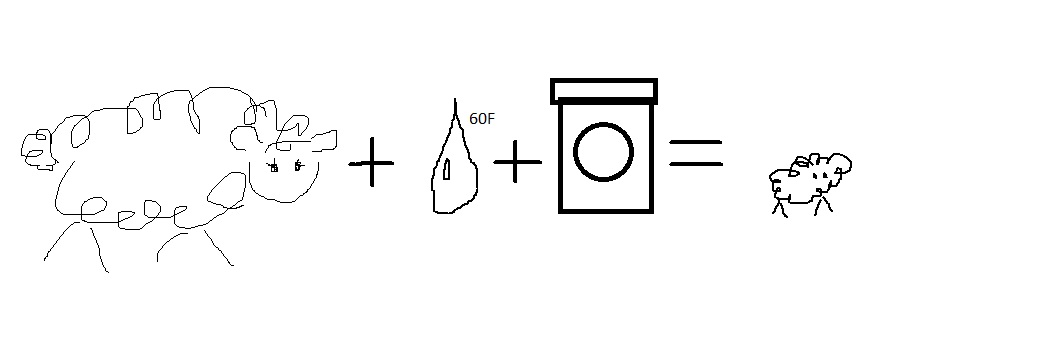
Precious hand knit+cold water+other clothes (mechanical agitation)=  Mom freaking out (emotional agitation)

We can simplify this formula for future reference:

PHK+H2O+MA=MF

Not even stoichiometry can save this one.

Put another way:

At least I have another skein of Mushishi.

For those who want to do it right…

Uncategorized

Being Objective.

Now that the new year is in full swing and \”looking back\” is done, it\’s time for me to get back to the business at hand–that is, as it relates to the study of knitting.

I am going to use the blog as a journal for learning, reflecting and recording mistakes. (After all, aren\’t blogs supposed to be online journals anyway?)

To this end, I will divide my posts as follows: Reading Reflections; Minutia; W\’sIP; New Projects;
Eureka!; OOPS!; Blog Stories; Toying with Design; and What I Learned on Ravlery.

Reading Reflections: May contain information about a book/article I have been reading (see list to left). I will talk about why I like a particular book or article, what I learned from it and why it might be a valuable resource going forward. May also just be a reaction to a reading, silly or otherwise. (Can\’t forget to be silly!)

Minutia: The little stuff. Details and very (seemingly) small matters. For example, learning to really SEE what twisted stitches look like and how to fix them if they were unintended.

WIP: Projects I am working on, what my learning objectives are, how it is working out–or not working out. Sometimes these are also known as UFO\’s. The difference is that a WIP is a project in your hands, a UFO is a project that has been in your knitting basket for so long that you start to wonder if it ever really existed. Just like an alien.

New Projects: May be simultaneous–new and ongoing projects will overlap. I plan to do a larger project \”in the background\” for a longer time and do a few smaller ones to learn new skills or just take a break!

Eureka!: Reserved for the \”AHA!\” moments, there will likely not be many of these posts.

OOPS!: There will be many more of these.

Blog Stories: I will not forsake the sillies when it comes to sharing my life in the ultimate City of Hipsters, Portland, Oregon.

Toying with Design: These posts will outline my ideas for design, my branching out a bit and then actually stepping out ONTO the branch and hopefully not falling to the ground. (I hope there is soft grass down there and that it will be a sunny day with a prince on a horse nearby to rescue me…and I hope the horse doesn\’t step on my fingers as they approach me as I lay on the ground…)

What I Learned on Ravelry: I have a lot of reading to do. A LOT. There is so much to learn about the knitting business! As much as I have read, I realize keenly that I have not even scratched the surface of the surface of the surface as it relates to the design business, or even the art of knitting for that matter. (Well, maybe I have scratched the surface of the surface on that one.) Ravelry has many forums and groups to help folks like me (and maybe you, too!) in the pursuit of one\’s bliss.

Onward! And may your yarn never slide off your needles…until you want it to.

Uncategorized

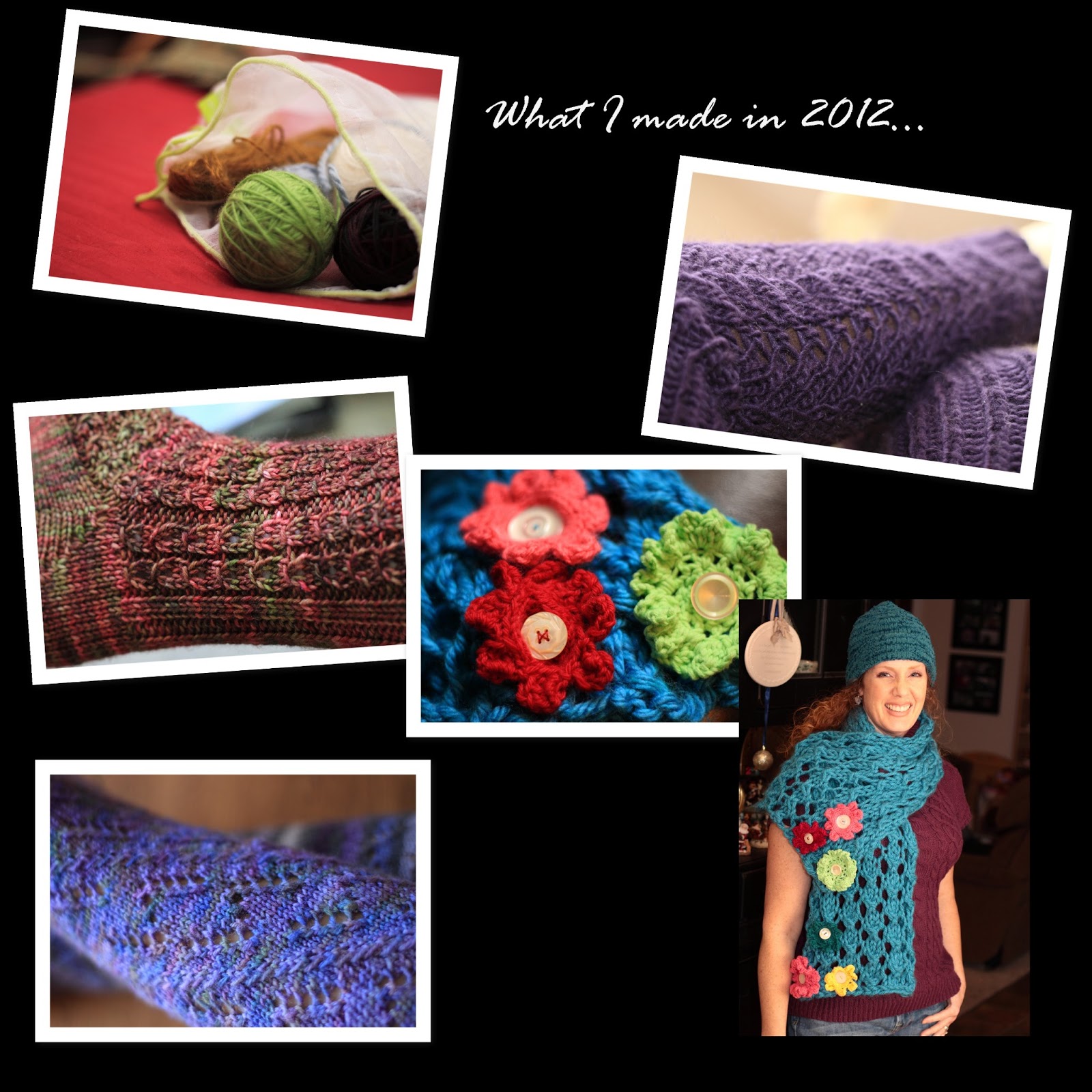
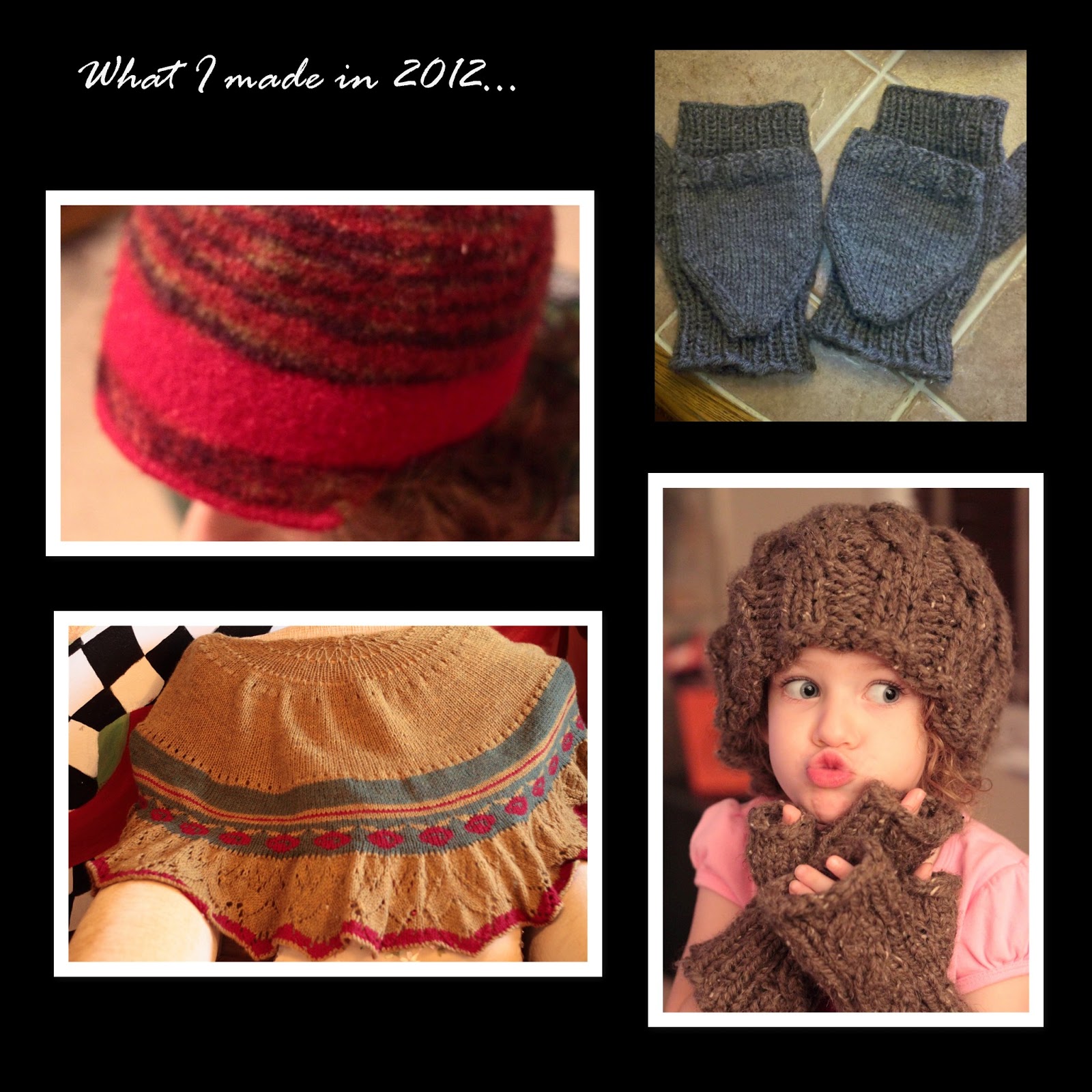
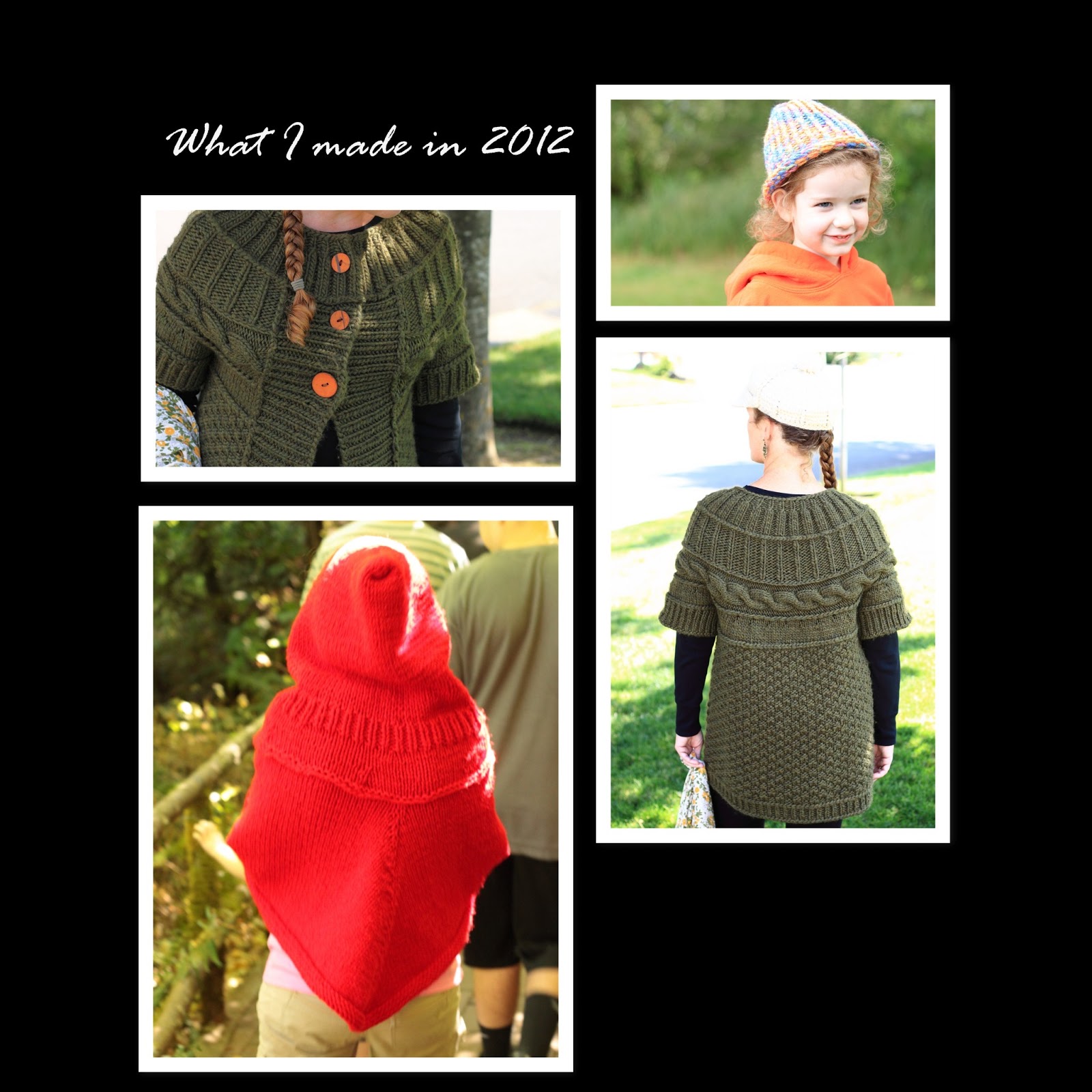
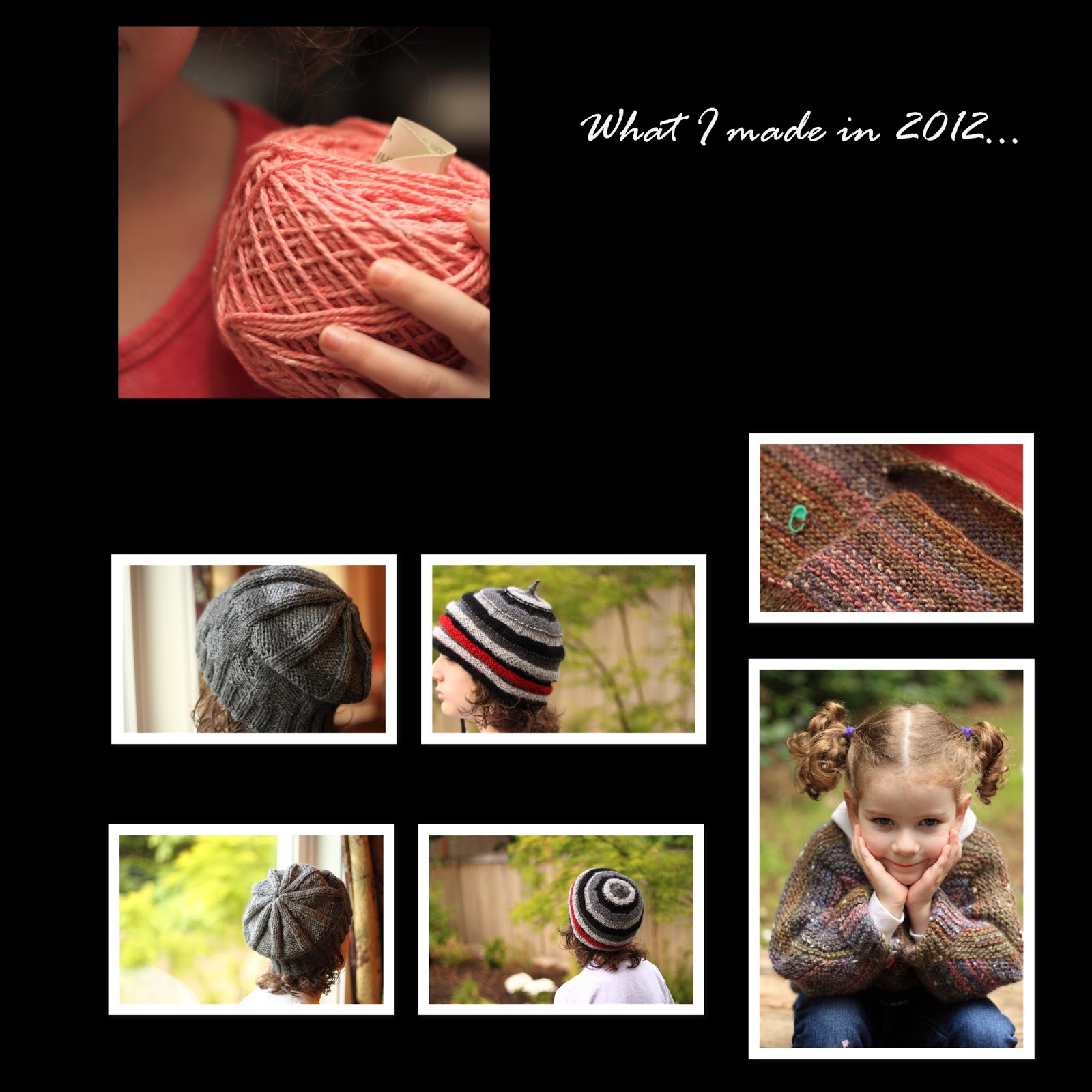
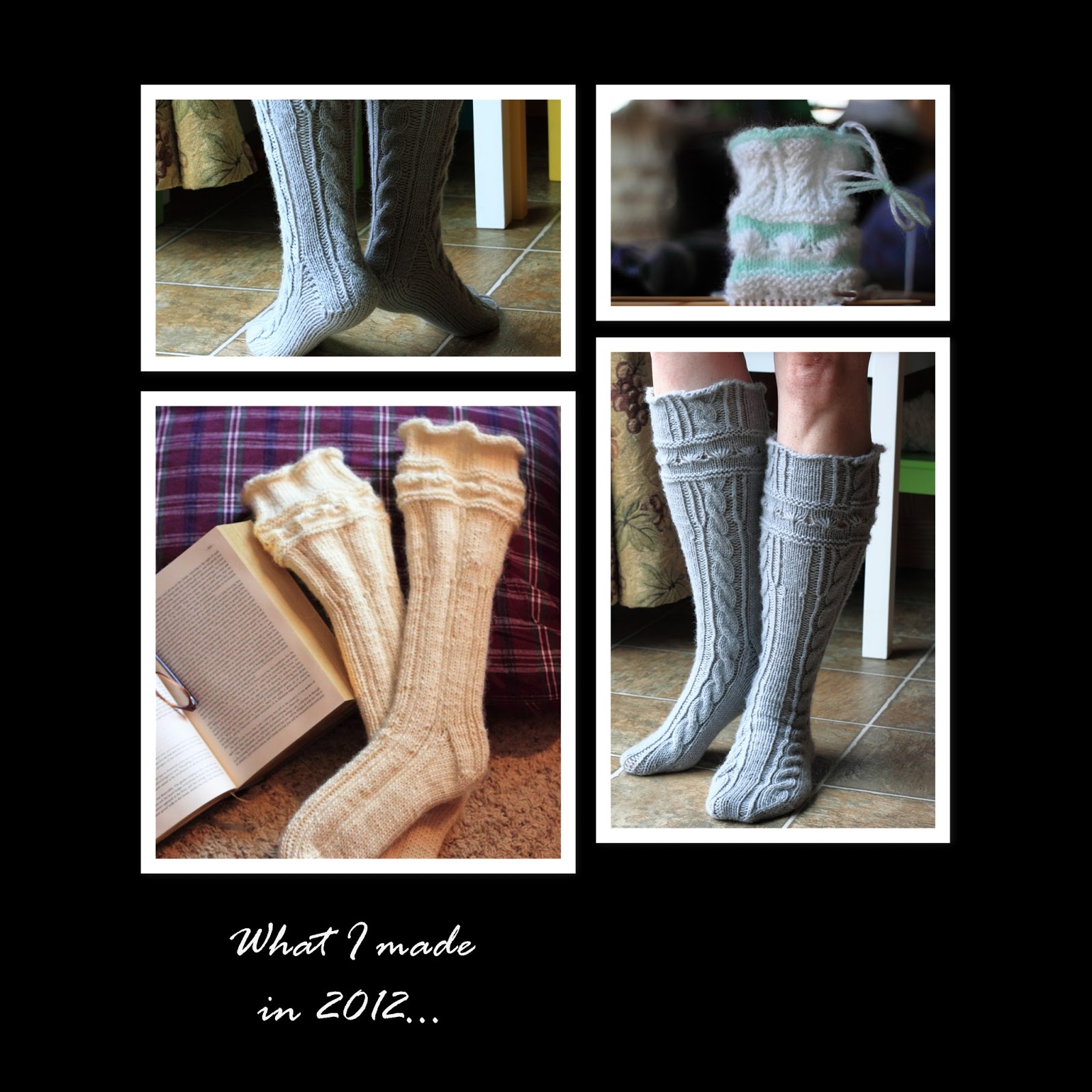
what i made in 2012…my first annual recap…


Not Pictured (given away too soon!):

2012: 36 total projects and an untold sum in yards of yarn. 

Thanks, Jona for the idea 🙂

Uncategorized

The Reading List

The start of a love affair with knitting
books, circa 2011/ 

Since I am a college-minded chick (meaning I enjoy school),  I have decided to approach my desire to succeed in knitting (see my terms in previous post) as though I were in college.

I like the way organized classes work: laying out learning objectives; giving students several types of resource options (eg. reference books, websites, textbooks); and finally giving them the chance to try out the knowledge.

I cannot attend the Oregon School of Art and Craft–too expensive and far away from where I live right now. Nor can I flee my family and career to live in New York or another fashion-trendy city and learn Ready to Wear design, considering majors in things like \”fiber\” or textiles. And I have had a difficult time finding online college courses for such things.

I must remain put here in Portlandia/The \’Couve (that\’s Vancouver, Washington, affectionately nicknamed by locals who love to call to mind the old white trash stereotype of Vancouver) and learn on my own, with the help of groups like Ravelry, the library, the local Fort Vancouver Knitting Guild and let\’s not forget all the LYS\’s and my own friends.

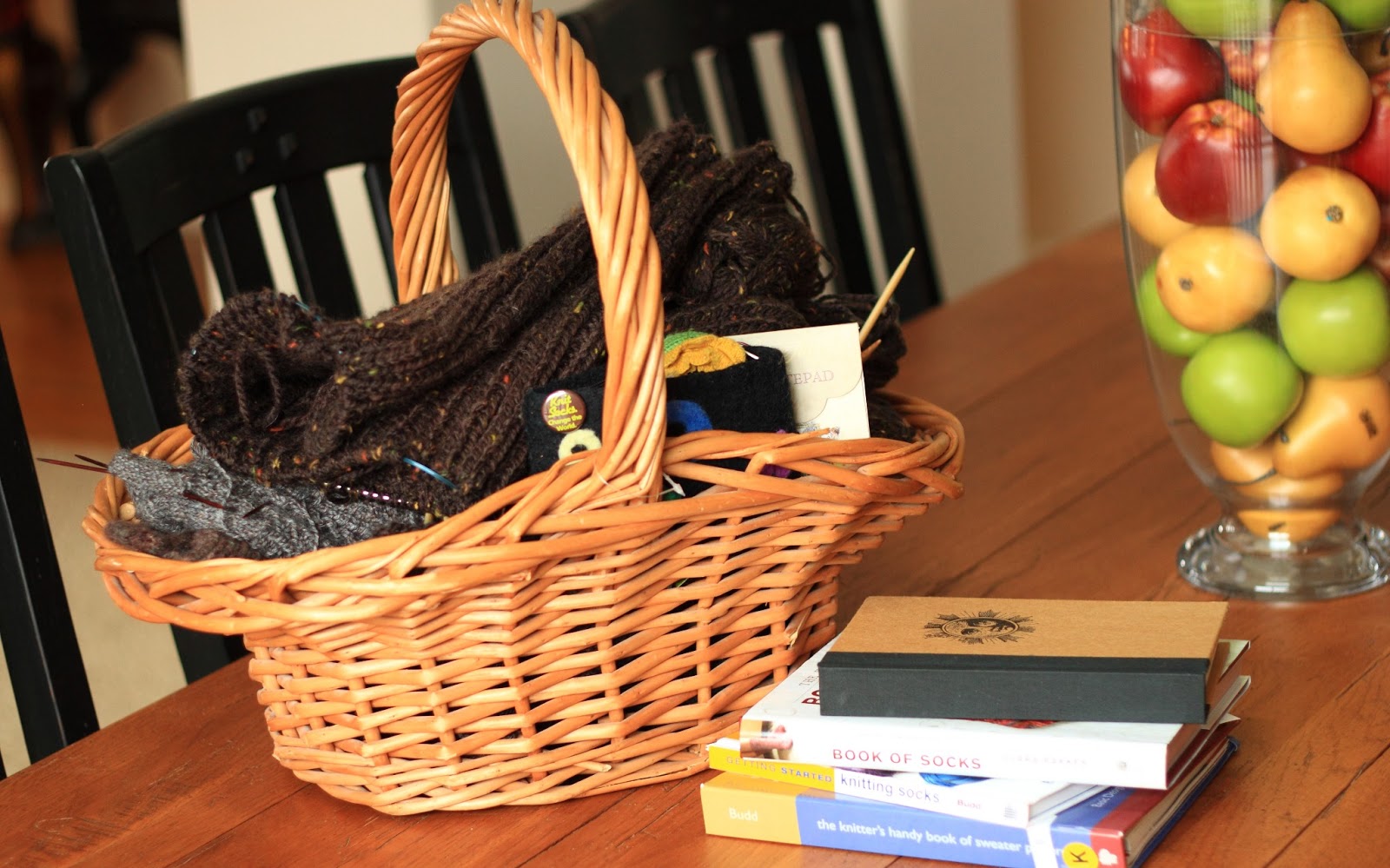
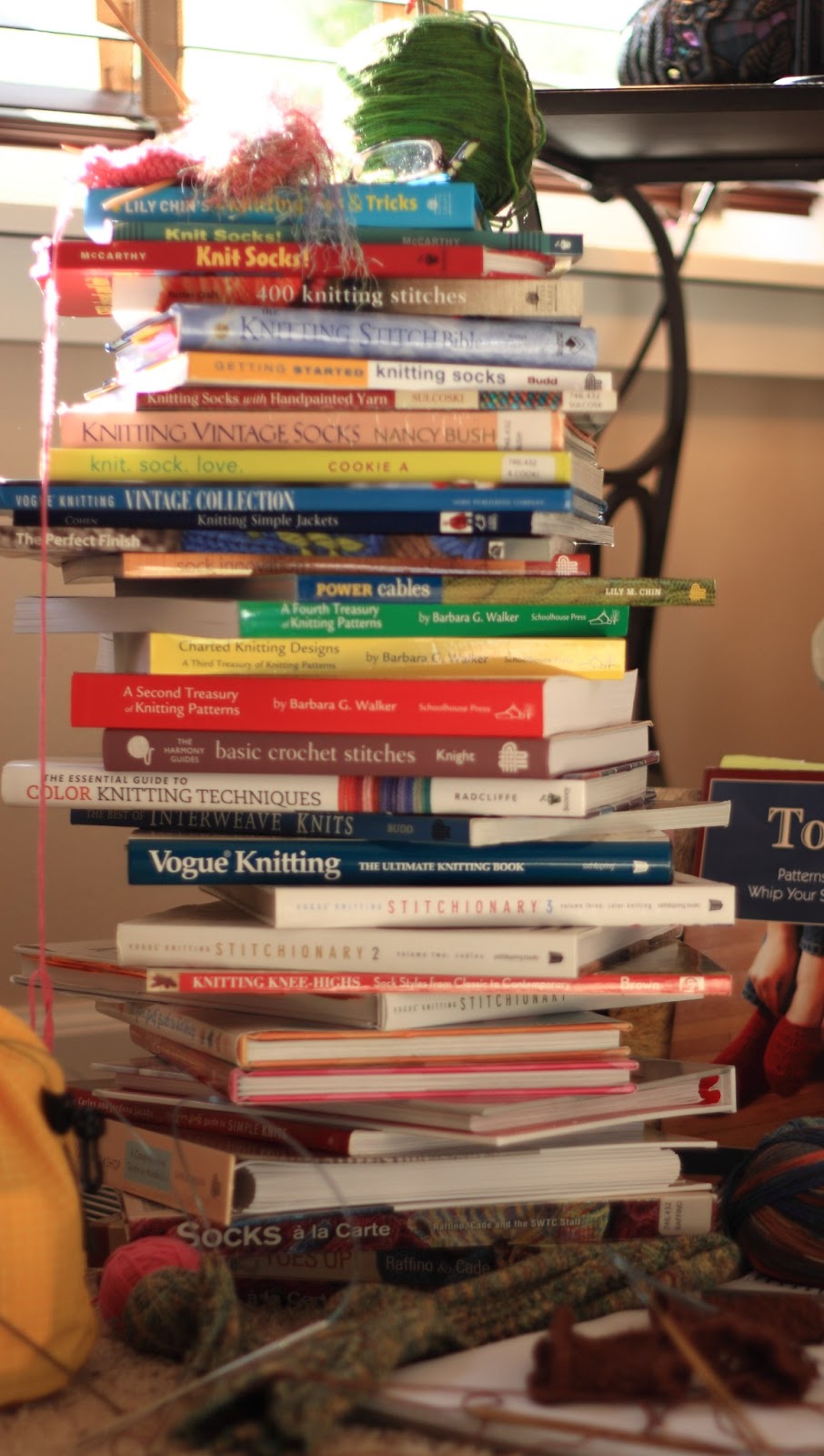
In fact, there is so much information available to aspiring knitters and designer wannabes that there is nearly no excuse not to be able to learn.This picture (left) of a stack of books was taken back when I was preparing for Sock Summit 2011. It reflects my \”earlier\” love of knitting books, collected from 2008 to spring 2011. That early love could have easily been a passing fancy as I am one of those people who gets excited–really excited–about new ideas, prospects, projects. And usually, I share the common quality with those other excitable people of very poor follow through. But not this time.

After 4 years of buying yarn, books and classes, of attending events and joining Ravelry, of making new knitterly friends wherever I find them, and even starting a knitting group of my own at work, I think it is safe to say that this is not a passing fancy for me. I love knitting more than ever–and now that I have such an arsenal of personal equipment, I am glad of it when it comes to  the study of knitting.

Since the book stack photo was taken, I have amassed many more, including 9 received as gifts for Christmas in 2012.

As the years have progressed, my book selections have evolved. It used to be that I would buy knitting books based on the lovely cover photos more than on the content. I am not immune to that today, but now I know that the books with the more scholarly approaches tend to be my favorites–and I intend to use them in my quest for more intense learning.

With that in mind, I am creating a booklist for myself. It is comprised of my own collection mostly, and if I do not own one of the books I feel I need as I go along, I will either get a copy from the library or–glee of glees–have an excuse to buy just one more. (Amazon should have me on some sort of gold star customer list)

To the left of the blog, I have listed some books, along with my (initial) intended use for them. Most of the books cross over multiple categories as they each cover a variety of topics from skill expansion to finishing to design to fiber info to just terrific and beautiful patterns and photography.

As I go along in my quest for knitting knowledge and skills, I may add or subtract reading and study materials, but I will start with some basics and go from there. After all, this is not going to be a short ride.

Uncategorized

What to do with knitting?

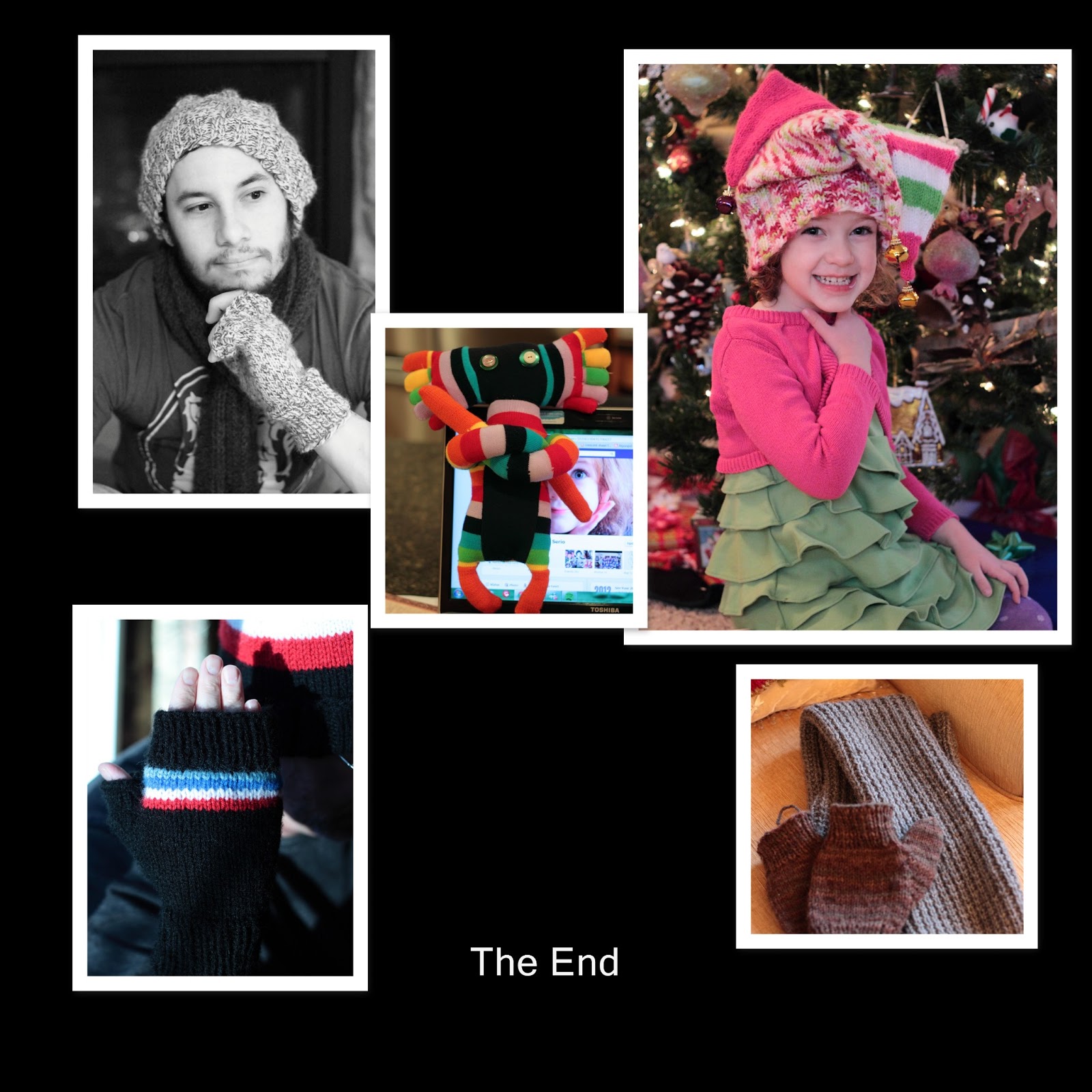
This is my daughter\’s boyfriend, Andrew
(sporting a knitted hat and mitts I made
for him). In this pic, he looks like
a thoughtful hipster. While he is not really
an official \”hipster,\” striking a thoughtful
pose may not be a bad idea.
Especially if it is only
mental.

As each year ends, I ask myself the same question: What do I want to do with knitting? 

Then is starts: What do I want to do this year? For the future? For my family? For my knitterly learning? How many months are in the year again? Do I knit small, faster items to learn more techniques? Or should I take on an epic project in fingering weight yarn that will take a whole year to complete by itself, knowing that I may (or may not) incidentally learn things along the way? 

My questions branch out like that–farther and farther, until they have developed into some kind of giant tree of dichotomous logic in reverse, with the overarching question left behind at the top, and the huge, tangled, expansive root-questions at the bottom.

For those of you who read the blog, you know this is really not only a perennial question for me but an ongoing and irritating one. I will not pretend to be the only irritated person, mind you. You may be irritated along with me, or even at me. I will not blame you.

To solve this irritation requires direction and I think I am ready to take on the daunting task of reigning in my scattered brain for a purpose: a greater knitting purpose that will eventually solve all my dilemmas.

If you will humor me, I will think out loud (in print) and start to sort this out. Maybe others may empathize. Who knows?

Here are some facts:

  • I learned to knit later in life, being 43 years old, and having only been a knitter now for 4 years.
  • I want to become a stellar knitstress before I die (or become too arthritic to do it)
  • I want to build my own personal wardrobe of socks and sweaters, gloves and hats
  • I want to provide my family and friends with really cool gifts 
  • I understand that these gifts may prompt more orders from the same folks (in fact, they already have)
  • In addition to making things for everyone and for myself, I want to become a knitwear designer, even if it is only for fun and part time
Here is another fact: there is not unlimited time for someone with a full time job, and 3 of 6 kids still at home, one of whom is 3. 
Here is another fact: those who never get organized and begin their journeys never get where they want to be going.
I can tell you from experience that this is true. I started college at 32 years old after just twiddling around with the idea for nearly 15 years. It took 6 years of hard work, but here I am. Finished. And, while learning never ends (thank God), college in the past and I did it.
I have decided that I will approach knitting in the same way. With purpose, with direction and with the will to learn.
Stay tuned.
Uncategorized

A Maiden in Her Own Mind

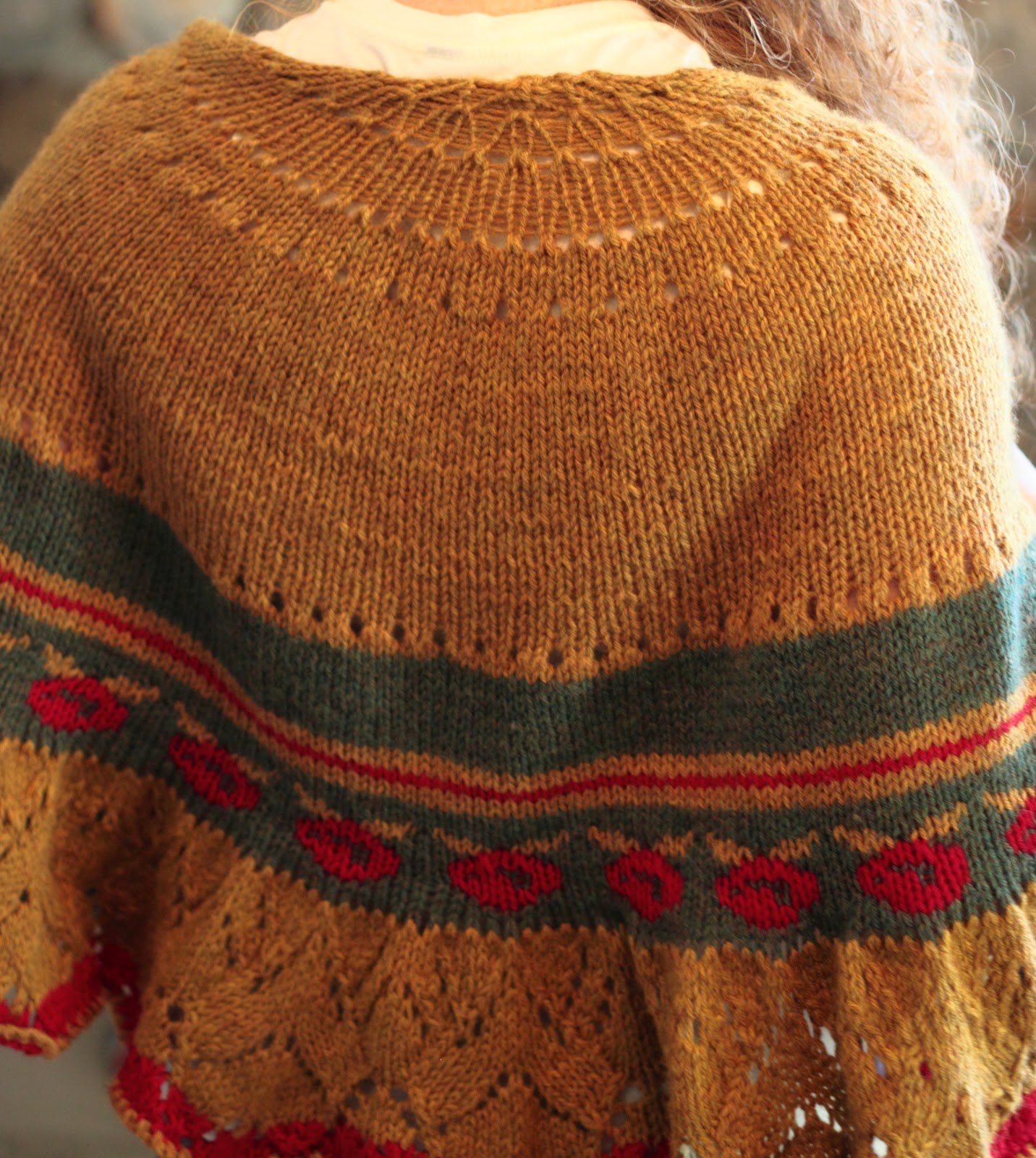
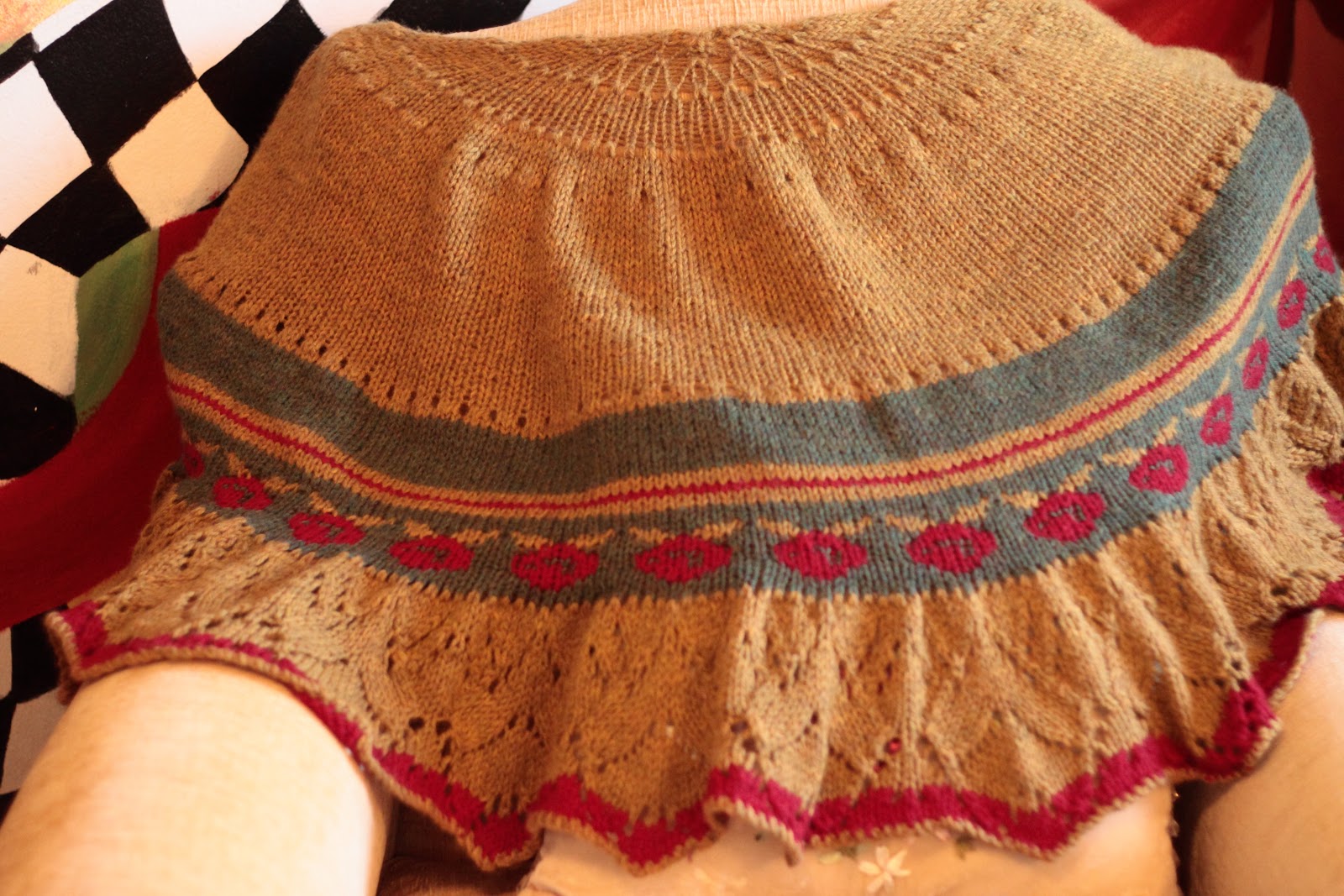
Goldenrod Shawlette, pattern by Marilyn Giselle Maupin. Embellished
by me.

Perhaps you have been saying, \”Where have you been, Janelle?\” or, \” What the heck am I following this blog for, anyway?\” Or perhaps you are in another camp, saying right now, \”Has it been a while? Funny. I didn\’t notice.\” Or worse yet, \”What is this line of discussion right now even about?\”

Well, whether you care or care not that the blog has been so quiet through the holidays, I am back and ready to rumble. That is, if \”rumbling\” can mean prattling on about anything that momentarily strikes my fancy.

Let\’s begin with what I have been up to–knittily speaking–all this time. After all, that is a lot of the fun to be found in knitting blogs.

Let\’s begin with a shawl. My first real shawl. Not a rectangular shape calling itself a wrap or stole (thought perhaps to be fancy non-shawl words to triangle shawl lovers) but a shawl. It is a crescent in shape and derived from a pattern designed by Marilyn Giselle Maupin, called Goldenrod Shawlette.

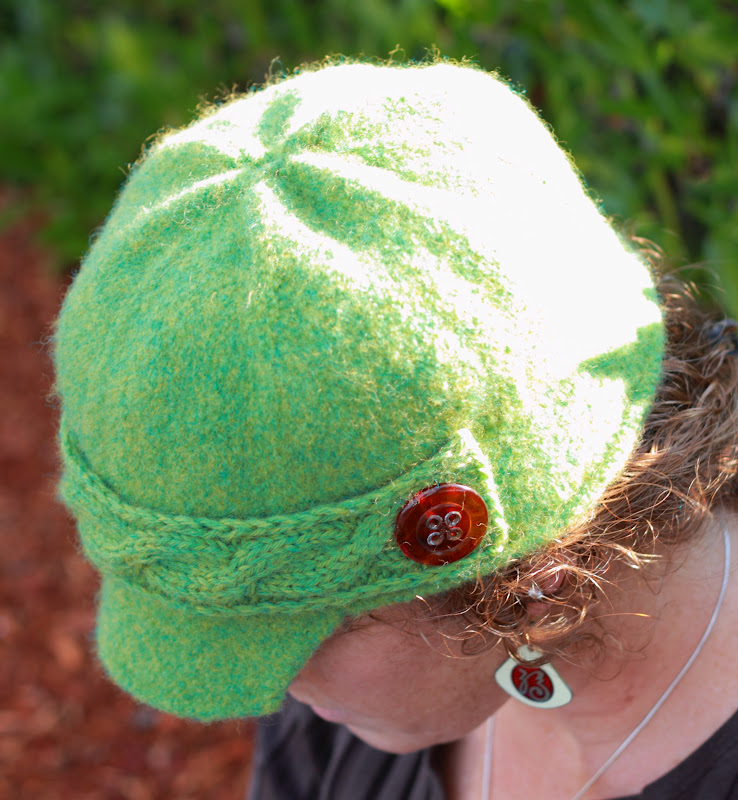
One day while trying to figure out how to make a diagonal top for a felted hat (that\’s another story for another time), I became curious about the way half moons and crescents were formed in knitting. I happened upon Miss Maupin\’s blog, KnitKat, where she has a nice post on the mathmatical formula for knitted crescents.

Long story short, I decided to knit one of her shawls to really understand the crescent idea. And it was really fun–except that now I can commiserate with other knitters when I hear them complain about how irritating it is to be doing 300 stitches in a single row and taking forever! (I guess I really am saying that I am now proud of the fact.)

Lucky for me, I went to stay with my daughter in Seattle for a weekend (sans my 3-year-old daughter and distract-er extraordinaire) where we did some serious power knitting into the night. (With the help of several episodes of MST 3000, of course.)

I added some fair isle colorwork from one of my stitch dictionaries, The Knitting Stitch Bible by Maria Parry-Jones (The rose pattern I used is found on page 193).

It was a fun and relatively quick project, in spite of the 300something stitches at one point. I made my shawl a little deeper than the original pattern as I added the rows of fair isle, which I kept even–no increases there–and I love it.

Every time I wear this shawl, (which I usually do with my white cotton, very old-fashioned style, sleeveless nightgown, complete with battenburg lace) I imagine how the women in Jane Eyre\’s (fictional, I know…) or Jane Austen\’s time would have felt on cold winter mornings, waiting to have their fires built in their rooms for them by the housemaids. Many country women probably even tried to balance their shawls on their shoulders while starting morning fires on their own.

This particular shawl would function well for the latter as the shaping in the pattern causes it to sit well on the shoulders; in the morning, I can flip the gas fireplace switch, grind and make the coffee and cut myself a pastry to got with it, all the while just enjoying the sweetness of the shawl and not ever having to readjust it.

I love the earthy colors I chose, too, as they are rustic and somehow (maybe incorrectly) bring to my mind a country maiden, padding across her wide, wooden paneled floors in stocking feet to make her morning fire. I think of this every day as I go through my own modern morning routine. It takes me to a peaceful place with a serene feeling of connectedness to those people of old.

Too much imagination? I think not. My imagination is a fabulous place to visit. Someday I may just stay there.

Uncategorized

Who Can Be Found Knitworthy?

My latest project/design. Now that I like the design, who
do I make it for?

Many years ago, I became pregnant with my fourth child. Of course, no matter how many children you may have, they are all special; I was excited. At that time, I was doing a lot of cross stitch, so I promptly went to the craft store to play out my excitement.

I selected for my baby an adorable cross stitch kit in sex-indiscriminate colors that pictured of a toy shelf complete with several adorable, old-fashioned toys, lined up in a purposefully tousled row. It had a place on the scrolled shelf for a name, birthdate, baby\’s weight… some of the more fun things you dream about during pregnancy.

I promptly brought it home and began to work voraciously on it. It was complex and large, and I knew that I would normally spend about a year and a half working on a project like that, but this time I wanted to finish it in less than 9 months in order to have it stretched, framed, hanging and ready in the baby\’s room.

Back then, I had this friend. We\’ll call her \”Jane,\” since I call all the disguised people in these stories \”Jane.\”

Shortly into my own pregnancy, Jane called. She was pregnant too, she announced, and our babies were due only a couple of weeks apart. This of course added to the excitement. I had never been able to share pregnancy alongside a friend. I was elated.

As I hung up the phone with Jane, I began to think. She and her husband had expected to have no children at all. They had been married for 17 years. They had tried many things–and had failed–to have a child. Just when she had given up, she became pregnant.

I looked at my cross stitch, which was laying on the couch near the phone. Sure, it was special to me, but oh how much more special it would be to my friend! I became giddy with the thought of such a surprise and got to work even harder on the project.

Driven by friendship and excitement, I completed the project with time to spare. I headed to the local frame shop and had the piece professionally stretched. I selected an exquisite birch frame that would match my friend\’s baby room, with a pale matte to match. It was beautiful.

I admired it at home for only a short time as I lived 3,000 miles from Jane at the time. Because I wanted it to arrive in time for her baby, time was of the essence. I packed it carefully to be sure it was safe in the mail, and I sent it.

I hadn\’t heard anything from Jane by the time our babies were born. They were both girls, born 3 weeks apart. I assumed of course, that she was busy–maybe too busy for thank you cards. I was busy, too, and in the excitement of a new baby in my own house, I forgot about the gift. For a time.

When the girls were nearly one, I hopped on a plane with my daughter (the other 3 kids stayed home with their dad for ease of travel, and, I thought, to emphasize the meaningful nature of the visit) and headed to Jane\’s house. Several times during my trip, I imagined the toy shelf cross stitch hanging on her baby\’s wall in tasteful arrangement.  I had also purchased another kit for myself, so the girls could have matching wall hangings and I imagined how special it would be to have them hanging 3,000 miles apart in different homes.

Once we arrived at Jane\’s house, she showed me the baby\’s room right away. No lovely cross stitched picture. There was another one, done by a woman at her husband\’s office, a small, lovely angel, but not mine. There was a quilt on the wall, too, on a wooden bar, that a mutual friend had made. I thought my gift was of higher quality. Tossing that last, catty, thought aside, we moved on.

She showed me gifts and toys, bedding and cards, but not once time did she mention my gift. I knew she had received it as I sent it through UPS and had a signature for it. It was certain after several days together: she was not going to even mention it.

In fact, she never did. Now, several years later, our daughters are still friends, but Jane and I have become distant and I never did quite finish my own daughter\’s wall hanging. Perhaps I misread the friendship. Perhaps a lot of things were misunderstood, but one thing stands out to this day: how do you know who you can trust with your handmade treasures?

In this season of gift making, it is hard to know. Most of us crafters have stories of gifts given and never seen again–hats never worn, scarves given away to third parties (or even fourth parties), even perhaps cookies never even tried, let alone eaten.

What is the best course of action?

There are of course, a few rules for these dilemmas, such as: never knit a man socks till you have a ring, lest he walk away from you while wearing them. Same goes for the more complex \”boyfriend sweater.\” (I would even say that last one requires an actual wedding.) Some say never give knitted to anyone but knitters. Maybe you have developed a few rules of your own. But no matter how many rules we come up with, it still can end in disappointment that feels like disaster.  Unless…

Do we knit for the praise, or do we knit for others because we love them? Do we give gifts to get back or out of the goodness of our hearts and the sheer joy of making the item? I do still have the memories of all those good feelings I experienced while making Jane the cross stitch, after all.

Part of me wants to say that we should give freely because we want to, because we live knowing we are inserting art into the world, because we are really saying \”I love you,\” to someone when we hand them that pair of lace anklets. That same part of me wants to rally around the obscure aunts living in distant lands, saying, \”Obscure Auntie, you make Ralphie that giant bunny suit!! And if he doesn\’t like it, make him another one!\” Maybe this is what the world needs!

The other–jaded–part of me says, \”Yeah, right, and maybe monkeys will fly out of my butt.\”

Where is the balance? I say craft carefully. Craftily, if you like. Do it with joy, do it in the spirit of giving while trying to discover who in your life is truly \”knitworthy,\” keeping in mind the receiver. Do it with love, plus a grain of truth and through reality-colored glasses. But do it.

Make no mistake, knitters, sewers and purveyors of shell art, you truly are adding to the joy and beauty in the world, big picture-wise, no matter what. I truly believe that and I will be thinking of how much I personally appreciate all of you during this approaching holiday season.

And I still say: happy knitting. Because you want to.